Entity SEO for Local Businesses: Teaching Search Engines Who You Are
Learn how to build a clear entity identity with structured data, NAP consistency, and Google Business Profile so AI and search engines recommend your business.
# Entity SEO for Local Businesses: Teaching Search Engines Who You Are
Most small business owners think about SEO in terms of keywords: "best pizza in Denver," "affordable plumber near me," "wedding photographer Austin." Keywords still matter, but search engines have moved far beyond simple keyword matching. They now try to understand entities — the real-world things behind the words.
Your business is an entity. So is your city, your industry, and every product you sell. When Google, Bing, or an AI assistant like ChatGPT tries to answer a question about your type of business, it looks for entities it can confidently identify and recommend.
If search engines cannot clearly identify who you are, what you do, and where you operate, they will recommend a competitor who made that job easier.
This guide explains what entity SEO is, why it matters for local businesses, and exactly how to build a clear entity identity — even without a technical background.
What Is an Entity in Search?
An entity is anything that is distinct, well-defined, and distinguishable. Google's documentation describes entities as things that exist independently — a person, a place, an organization, a concept.
"Tony's Auto Repair in Boise, Idaho" is not just a string of keywords. It is a specific thing in the real world with a physical address, a phone number, operating hours, services, and a reputation.
Search engines build a knowledge graph of how entities relate to each other. Tony's Auto Repair connects to the entity "Boise, Idaho," to the entity "auto repair," and to related entities like "brake service" and "oil change." The stronger those connections, the more confidently a search engine can recommend Tony's shop.
Why This Matters More Now
Two shifts have made entity SEO critical for local businesses:
AI-powered search answers. Google's AI Overviews, ChatGPT, Perplexity, and other AI tools generate direct answers. They don't just list ten blue links — they recommend specific businesses by name. To get recommended, your business must exist as a clear entity in the systems these tools draw from.
Voice and conversational search. When someone asks their phone "where should I get my brakes done near me," the assistant picks one or two businesses to mention. It picks the ones it understands best.
If your business entity is fuzzy — inconsistent information across the web, missing structured data, no clear connection between your name and what you do — you will be skipped.
The Five Pillars of Local Entity SEO
Building a clear entity identity requires consistent signals across multiple channels. Here are the five areas that matter most.
1. Claim and Complete Your Google Business Profile
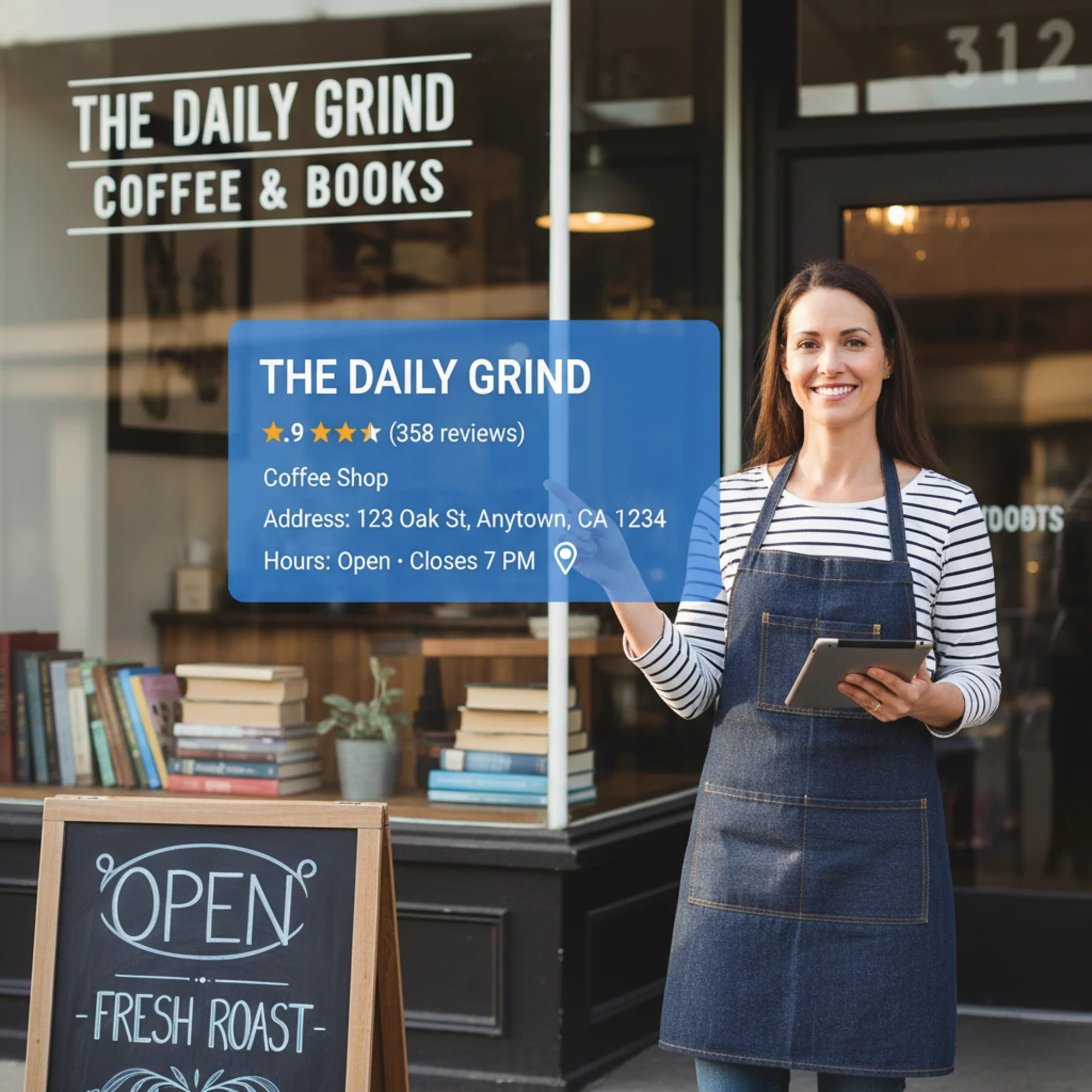
Your Google Business Profile (GBP) is the single most important entity signal for a local business. It is Google's primary source for understanding who you are.
What to do:
- [ ] Claim your profile at business.google.com if you haven't already
- [ ] Fill in every field — business name, address, phone, hours, category, description, services, attributes
- [ ] Choose the most specific primary category available (e.g., "Neapolitan Pizza Restaurant" instead of just "Restaurant")
- [ ] Add secondary categories for other services you offer
- [ ] Upload real photos of your business, team, and work — at least 10
- [ ] Write a business description that naturally includes your business name, city, and core services
- [ ] Keep hours updated, including holiday hours
Common mistake: Using a slightly different business name on your GBP than on your website. If your legal name is "Smith & Associates Consulting LLC" but your sign says "Smith Consulting," pick one and use it everywhere.
2. Nail Your NAP Consistency
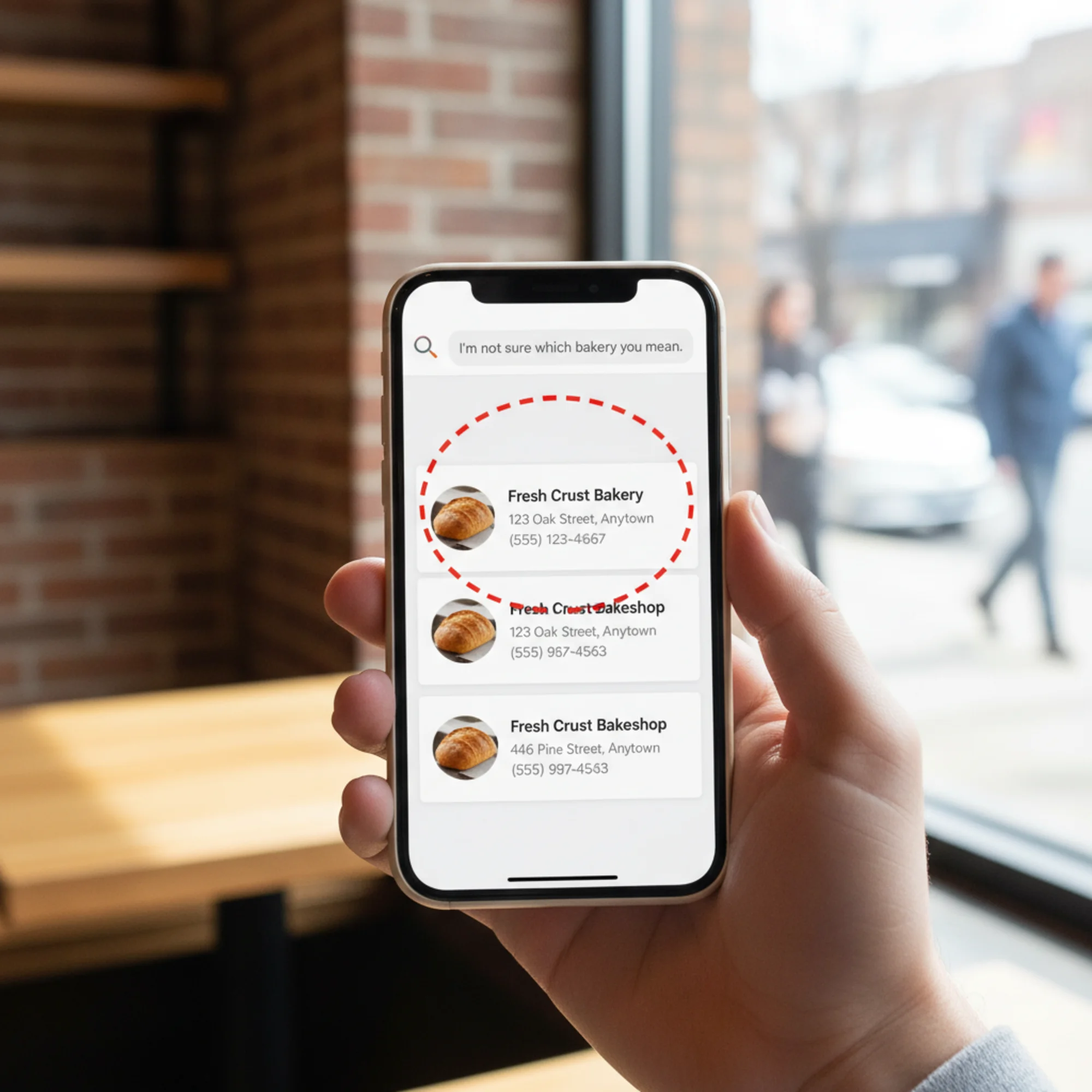
NAP stands for Name, Address, Phone number. Inconsistent NAP information across the web is one of the most common reasons local businesses have weak entity signals.
Search engines cross-reference your information across dozens of sources: your website, Google Business Profile, Yelp, Facebook, Apple Maps, industry directories, the Better Business Bureau, and more. Every mismatch creates doubt.
What to check:
- [ ] Is your business name spelled exactly the same everywhere? (Watch for "St." vs "Street," "&" vs "and," abbreviations)
- [ ] Is your address formatted identically? (Suite numbers, unit numbers, street abbreviations)
- [ ] Is your phone number the same across all profiles? (One primary number, not a mix of cell, office, and tracking numbers)
- [ ] Is your website URL consistent? (www vs non-www, http vs https)
Example: Sarah runs "Pampered Paws Pet Spa." On her website, the footer says "Pampered Paws Pet Spa, 142 Oak Street, Suite B, Portland, OR 97201." On Yelp, her listing says "Pampered Paws, 142 Oak St Ste B, Portland, Oregon." On Facebook, it says "Pampered Paws Pet Spa LLC, 142 Oak Street, Portland, OR."
To a human, these are obviously the same business. To an algorithm building an entity profile, these are three potentially different businesses. The LLC on Facebook, the missing suite number, the abbreviated street — each inconsistency weakens the signal. Sarah should pick one exact format and update every listing to match.
3. Add Structured Data to Your Website
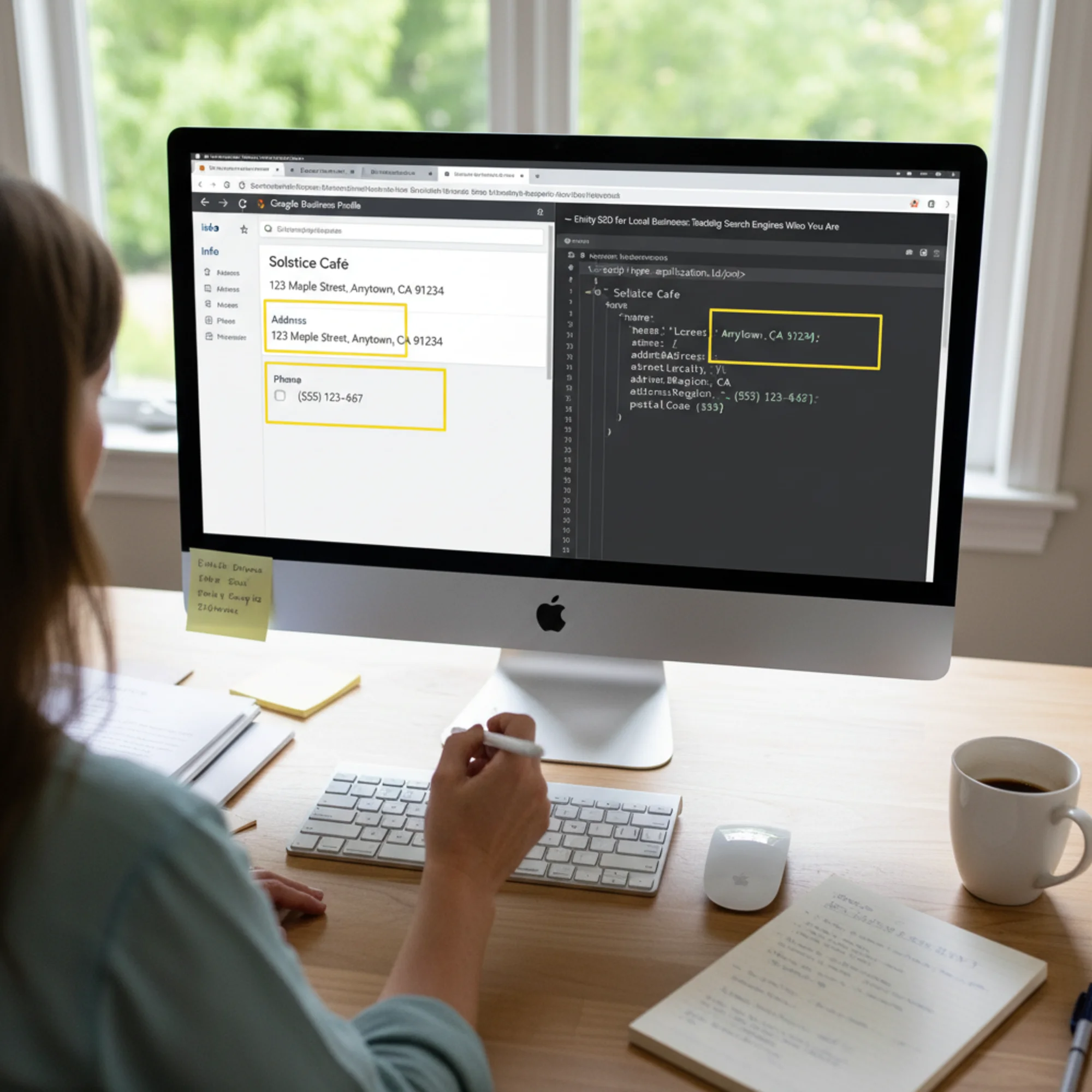
Structured data (also called schema markup) is code on your website that explicitly tells search engines what your business is. It is the most direct way to communicate your entity identity.
For a local business, you want LocalBusiness schema (or a more specific subtype like Restaurant, Dentist, or AutoRepair) on your homepage at minimum.
Here is what a basic LocalBusiness schema looks like:
{
"@context": "https://schema.org",
"@type": "AutoRepair",
"name": "Tony's Auto Repair",
"address": {
"@type": "PostalAddress",
"streetAddress": "823 Main Street",
"addressLocality": "Boise",
"addressRegion": "ID",
"postalCode": "83702"
},
"telephone": "+1-208-555-0142",
"url": "https://www.tonysautorepair.com",
"openingHours": "Mo-Fr 08:00-17:30, Sa 09:00-14:00",
"geo": {
"@type": "GeoCoordinates",
"latitude": 43.6150,
"longitude": -116.2023
},
"sameAs": [
"https://www.facebook.com/tonysautorepairboise",
"https://www.yelp.com/biz/tonys-auto-repair-boise"
]
}
Key fields to include:
- [ ]
@type— use the most specific type from schema.org (not just "LocalBusiness") - [ ]
name,address,telephone— matching your NAP exactly - [ ]
url— your website - [ ]
openingHours— current business hours - [ ]
geo— latitude and longitude coordinates - [ ]
sameAs— links to your social profiles and directory listings - [ ]
priceRange— helps with filtered searches - [ ]
areaServed— the geographic areas you cover
The sameAs property is particularly important. It tells search engines, "This Facebook page, this Yelp listing, and this website are all the same entity." It draws explicit connections that strengthen your entity profile.
Not sure whether your site already has structured data? Check with a structured data testing tool or run a free audit to see what is missing.
4. Build Entity-Supporting Content
Your website content should reinforce your entity identity. This means going beyond generic service descriptions and creating content that connects your business to specific places, services, and topics.
About page with entity-rich information. Don't just say "We are a family-owned business." Include your founding year, founder names, city, neighborhoods you serve, certifications, and affiliations. Each detail is an entity signal.
Service pages tied to locations. If you serve multiple areas, create pages that connect your services to specific cities or neighborhoods. "Roof Repair in Beaverton" is an entity-rich page. "Our Services" is not.
Content that demonstrates niche expertise. A dentist who publishes a clear, helpful guide about "What to Expect During a Root Canal" builds topical authority that strengthens their entity profile in the dental care space.
What to avoid: Thin pages that exist only for keyword targeting. Publishing twenty pages that all say roughly "We do [service] in [city]" with barely different content will hurt, not help. Each page needs to provide genuine value. Google's helpful content guidelines are clear: content should demonstrate experience, expertise, authoritativeness, and trustworthiness.
5. Earn References from Other Entities
Search engines build confidence in your entity when other known entities reference you. This is related to traditional link building, but the focus shifts from raw link count to who is referencing you and how clearly they identify you.
High-value entity references:
- [ ] Local Chamber of Commerce membership and listing
- [ ] Industry association directories (e.g., your state's bar association, contractors' board)
- [ ] Local newspaper or blog mentions that include your full business name and location
- [ ] Partnerships with other local businesses that link to your site
- [ ] Sponsorships of local events, teams, or organizations
- [ ] Supplier or manufacturer "find a dealer" pages
What makes a reference entity-rich: A link from a local newspaper that says "Tony's Auto Repair (823 Main Street, Boise)" is far more valuable for entity SEO than a link that says "click here." The surrounding text provides context that helps search engines connect the entity.
A Real-World Entity Audit Walkthrough
Here is what an entity audit looks like for a fictional business: "Green Leaf Landscaping" in Austin, Texas.
Step 1: Check the website.
The homepage has no structured data. The footer shows the business name and a phone number but no address. The about page mentions "Central Texas" but never specifically says "Austin." There are no links to social profiles.
Step 2: Check Google Business Profile.
The profile exists but lists the business as "Greenleaf Landscaping" (one word). Hours are marked "temporarily closed" from three months ago. Only two photos are uploaded.
Step 3: Check directory listings.
Yelp has "Green Leaf Landscaping LLC." Facebook has "Green Leaf Landscape Design." The BBB has no listing. Apple Maps has an outdated phone number.
Step 4: Identify the problems.
Four different name variations across five platforms. Missing address on the website. No structured data. Stale GBP information. No sameAs connections. AI assistants looking for a landscaper in Austin have very little confidence that this is a real, active business.
Step 5: Fix it.
- Decide on the canonical business name: "Green Leaf Landscaping"
- Update every listing to use that exact name
- Add full address to the website footer
- Add LocalBusiness structured data with
sameAslinks to all profiles - Update GBP hours, add photos, fix the name
- Correct the phone number on Apple Maps
- Create an About page that states the business name, location, and service area
- Apply to the local Chamber of Commerce directory
This work takes a few hours spread across a couple of days. But the combined effect is significant — you go from a fragmented presence to a clear entity that search engines and AI systems can reliably identify and recommend.
How to Check Your Entity Health
Here is a quick self-audit you can do right now:
- Search your exact business name in quotes. Does a Knowledge Panel appear on the right side of Google? If not, your entity signals are weak.
- Ask an AI assistant about your business. Open ChatGPT or Gemini and ask "Tell me about [Your Business Name] in [Your City]." Can it give an accurate answer? If it hedges or gets details wrong, your entity profile needs work.
- Check your structured data. Use a testing tool to see if LocalBusiness schema is present on your site and whether it matches your GBP exactly.
- Audit your listings. Check Google, Yelp, Facebook, Apple Maps, and industry-specific directories. Is your NAP identical across all of them?
- Run a full site audit. A comprehensive audit catches missing structured data, incomplete metadata, and other technical issues that weaken your entity signals.
Ready to see where you stand? Run a free website audit with FreeSiteAudit to get an instant report on your structured data, metadata, and the technical foundations that support your entity identity. It takes less than a minute, and you will know exactly what to fix first.

Quick-Reference Entity SEO Checklist
Use this as a recurring checklist — entity information drifts over time as you change phone numbers, move locations, or adjust hours.
Website:
- [ ] LocalBusiness structured data on homepage with correct
@type - [ ]
sameAslinks to all active social and directory profiles - [ ] Full NAP in website footer matching all other listings exactly
- [ ] About page with founding details, location specifics, and service areas
- [ ] Service pages with location-specific content where relevant
Google Business Profile:
- [ ] All fields completed
- [ ] Most specific primary category selected
- [ ] Hours current including special hours
- [ ] At least 10 photos uploaded
- [ ] Business description includes name, city, and core services
Directory Listings:
- [ ] NAP identical across Google, Yelp, Facebook, Apple Maps, BBB
- [ ] Industry-specific directories claimed and updated
- [ ] Old or duplicate listings removed or merged
Ongoing:
- [ ] Review listings quarterly for accuracy
- [ ] Update hours for holidays and seasonal changes
- [ ] Respond to reviews (activity signals an active entity)
- [ ] Add new photos regularly
The Bottom Line
Entity SEO is not a separate strategy from regular SEO — it is the foundation underneath it. Keywords help people find content. Entities help search engines understand who created that content, where they are, and whether they can be trusted.
For local businesses, the opportunity is significant because most competitors are not doing this work. They have inconsistent listings, missing structured data, and vague website content. By clearly defining your entity across the web, you make it easy for search engines and AI assistants to choose you.
Start with your Google Business Profile and your website's structured data. Fix your NAP consistency. Then build from there. The work is straightforward, the tools are free, and the impact compounds over time as search engines grow more confident in who you are.
Sources
Check your website for free
Get an instant score and your top 3 critical issues in under 60 seconds.
Get Your Free Audit →