How ChatGPT Decides Which Websites to Recommend (And How to Get Picked)
A plain-English guide explaining the signals ChatGPT uses to recommend websites, with practical steps small business owners can take to get cited in AI answers.
# How ChatGPT Decides Which Websites to Recommend (And How to Get Picked)
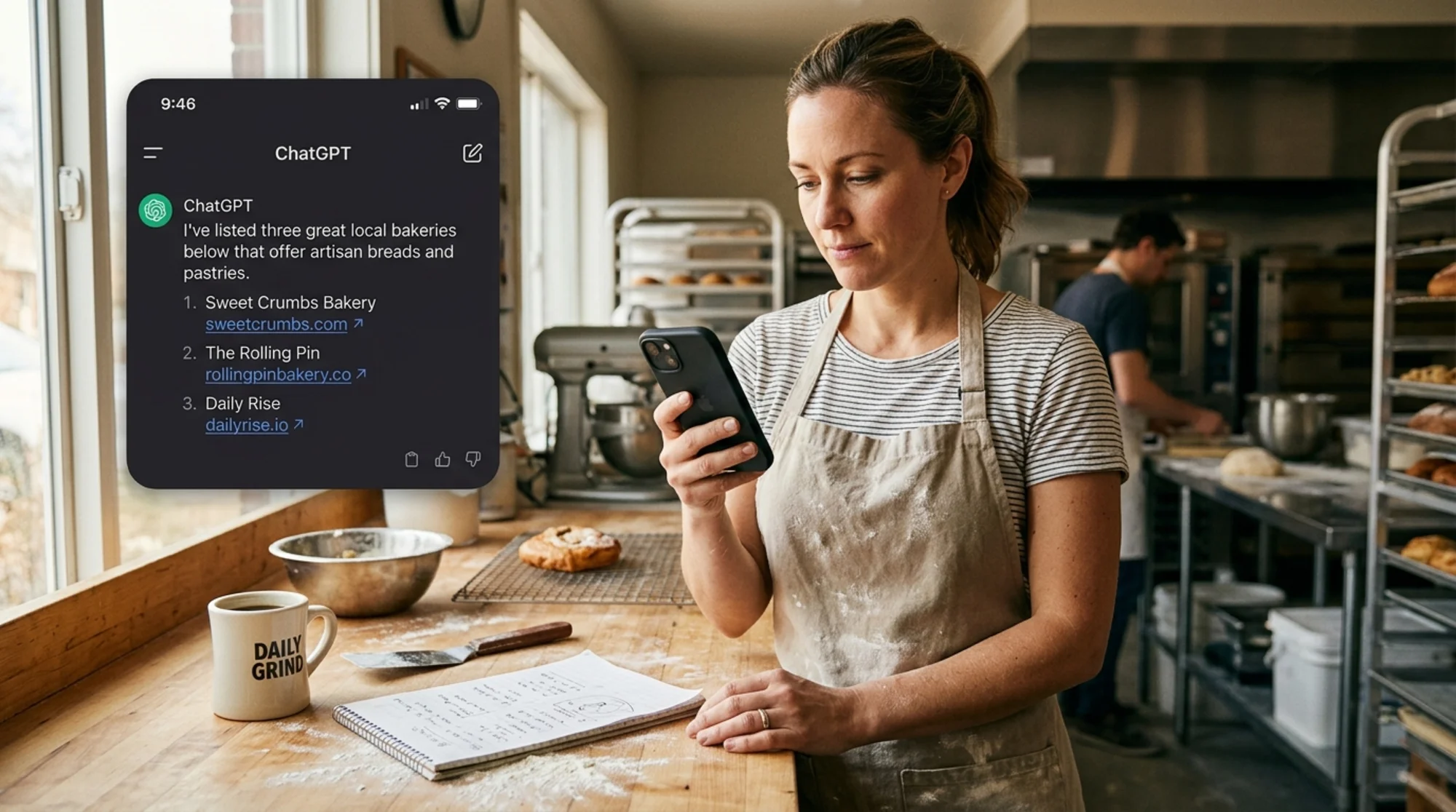
A customer types "best accountant for freelancers in Austin" into ChatGPT. A few seconds later, the answer includes a short list of three websites. Two are firms you've never heard of. The third might be yours. Or it might not.
If you run a small business, this scenario is no longer hypothetical. People are asking ChatGPT, Perplexity, Gemini, and Claude the same kinds of questions they used to type into Google. The AI usually names a handful of sites — not ten blue links, just a few. Getting on that list matters. Getting cut from it hurts.
This post explains, in plain English, how ChatGPT actually chooses which websites to surface, and what you can do about it. No hype, no insider tricks — just the signals that move the needle.
How ChatGPT Actually Gets to a Recommendation
ChatGPT does not maintain a live ranked list of "the best websites" the way Google's index does. When it recommends a site, one of two things is happening.
Path 1: Browsing-enabled answers. For current, real-world questions ("best plumbers near me," "cheapest CRM for a 3-person team"), ChatGPT runs a live web search behind the scenes, reads the top results, summarizes them, and cites the most useful sources. Your site is being picked from a fresh search result.
Path 2: Training-data answers. For more general questions ("what's good accounting software for freelancers"), ChatGPT may answer from what it learned during training. Sites that appear often, are written clearly, and are referenced by trusted sources are much more likely to be remembered by name.
Both paths reward the same things: clear writing, trustworthy publishing, structured pages, and being widely cited. The signals overlap heavily with the ones Google uses for traditional search. That is good news — you don't need a separate "ChatGPT strategy." You need a site that is genuinely useful and easy for machines to read.
The Six Signals ChatGPT Pays Attention To
1. The Page Directly Answers a Real Question
A page titled "Our Services" with three paragraphs about "passion for excellence" will not get cited. A page titled "How much does a small business tax return cost in 2026?" with the answer in the first paragraph absolutely can.
The fix is structural. Use H2 and H3 headings that look like questions. Put the answer in the first one or two sentences underneath, then expand. AI models scan for question-answer pairs and grab the cleanest one.
2. Author and Business Credibility Is Visible
Google calls this E-E-A-T (Experience, Expertise, Authoritativeness, Trust), and AI tools use similar logic. They are essentially trying to avoid recommending anonymous blogs.
For small business sites, that means:
- A real author byline on blog posts with a short bio
- An "About" page that names the owner, team, founding year, and location
- Contact details visible on every page
- Reviews and testimonials that name the customer and what they bought
These don't have to be elaborate. They have to be present and consistent.
3. Structured Data Helps Machines Read the Page
Structured data is a small block of code that labels what's on the page: this is a product, this is the price, this is the review rating, this is the FAQ. Google's Article structured data documentation lays out the format clearly.
You don't have to write it by hand. Most platforms (WordPress with Yoast or Rank Math, Shopify, Squarespace, Wix) add basic schema automatically. What you need to check is that it's actually present and accurate. A plumbing services page should be labeled as a LocalBusiness with address, hours, and service area. A blog post should be an Article with an author. An FAQ section should use FAQPage schema.
To ChatGPT's search backend, structured data is a label-maker for content. It removes ambiguity.
4. The Site Loads Fast and Works on Mobile
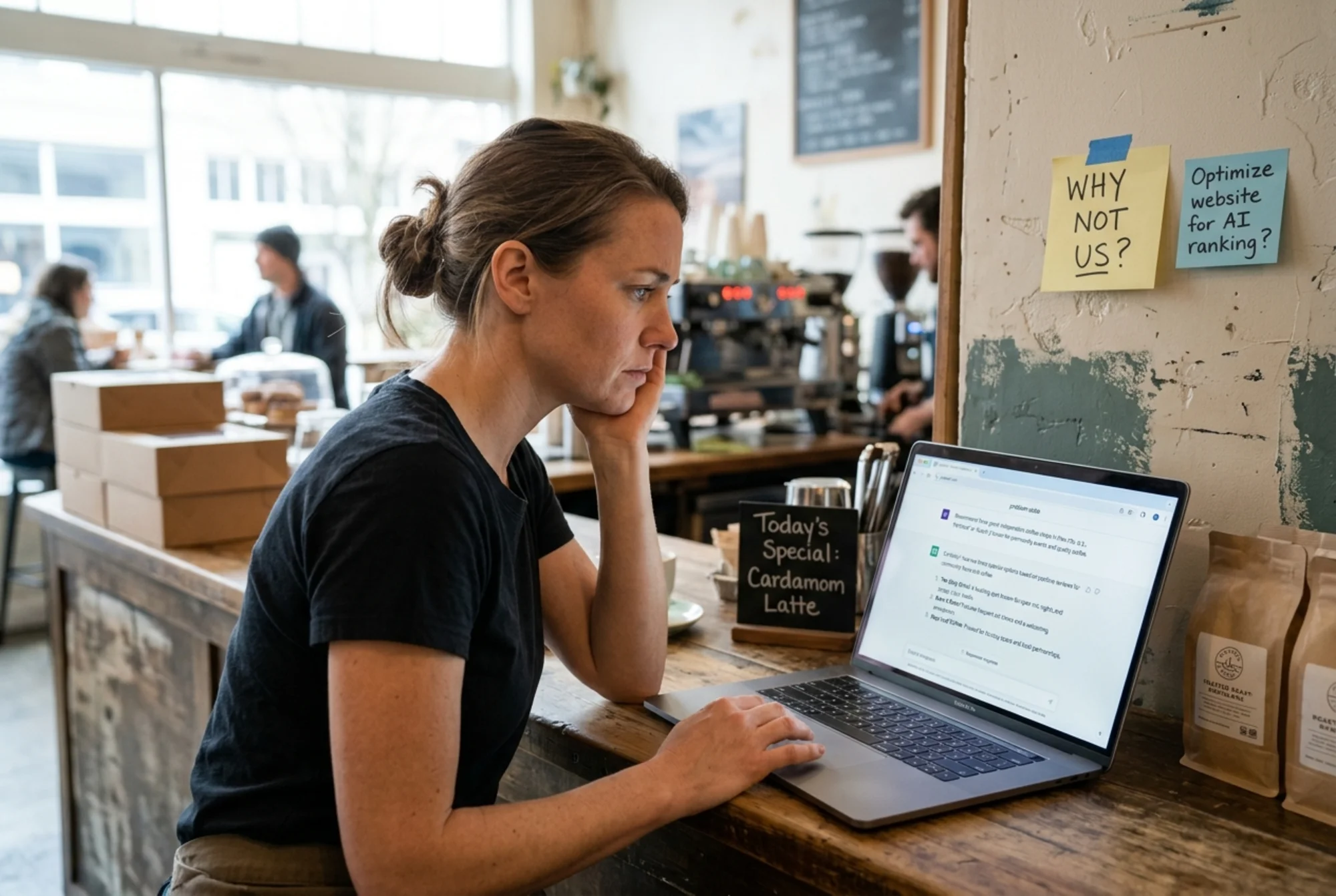
ChatGPT's browsing layer relies on the same web infrastructure as regular search. Pages that time out, are too heavy on mobile, or hide content behind aggressive popups get skipped. Google's Web Vitals guidance (LCP, INP, CLS) applies directly.
The mistakes that hurt small business sites most:
- Hero images that are 4MB and uncompressed
- A cookie banner that covers the screen for 8 seconds
- A chat widget that loads before the main content
- A theme stacked with 30 fonts and a dozen tracking scripts
If a real human gives up before your page renders, an AI crawler will too.
5. The Site Is Cited by Other Trusted Sources
ChatGPT, like search engines, treats inbound mentions as votes. If your local chamber of commerce links to you, a trade publication quotes you, a review site lists you, or a customer's blog names you — it all adds up.
For small businesses, the realistic sources are:
- Local directories (Google Business Profile, Bing Places, Yelp, industry-specific listings)
- Local press and trade publications
- Partnerships with complementary businesses
- Guest posts on niche blogs in your space
- Podcast interviews with show-notes links
You don't need 10,000 backlinks. You need a handful from places that are themselves trustworthy in your niche.
6. The Content Doesn't Look Like Filler
This is the signal small business owners underestimate. AI models are trained to deprioritize content written for SEO rather than humans. Keyword-stuffed paragraphs, "in today's fast-paced world" openers, lists of synonyms, and word-count padding get filtered out.
Google's Helpful Content guidance is blunt: write for people first, and write things only someone with real experience could write. AI tools have absorbed the same standard.
A Specific Walkthrough: The Bakery on the Corner
Imagine you run a small bakery in Portland. Someone asks ChatGPT: "Where can I get a custom birthday cake in Portland with two days' notice?"
For your site to be one of the three named, several things probably need to be true.
There is a page whose title or H1 includes "custom birthday cake" and "Portland." Not buried in a paragraph — at the top, where a machine reading the page sees it immediately.
That page directly answers the lead-time question. The first paragraph says something like, "We accept custom birthday cake orders with 48 hours' notice in most cases, and 72 hours on weekends." Specific, clear, no hedging.
The page lists what's possible: flavors, sizes, dietary options, price ranges. A short FAQ near the bottom answers the next obvious questions — Can you deliver? Do you do gluten-free? What's the smallest size? — and it's marked up with FAQPage schema.
The page shows credentials. "Baked by Maria Chen, head pastry chef, trained at Le Cordon Bleu, 12 years in Portland." There's a photo of Maria and three customer reviews with names and dates.
The page loads in under two seconds, looks clean on a phone, and isn't covered by a popup.
Two or three other Portland sites link to it. The local food blog has a "best custom cakes" post. The wedding planner two blocks down has you on their preferred-vendors list. Your Google Business Profile is filled out completely.
That set of conditions is what makes you citable. None of it is exotic. All of it is achievable in a week of focused work.
A Mini-Checklist for Each Page You Want Cited
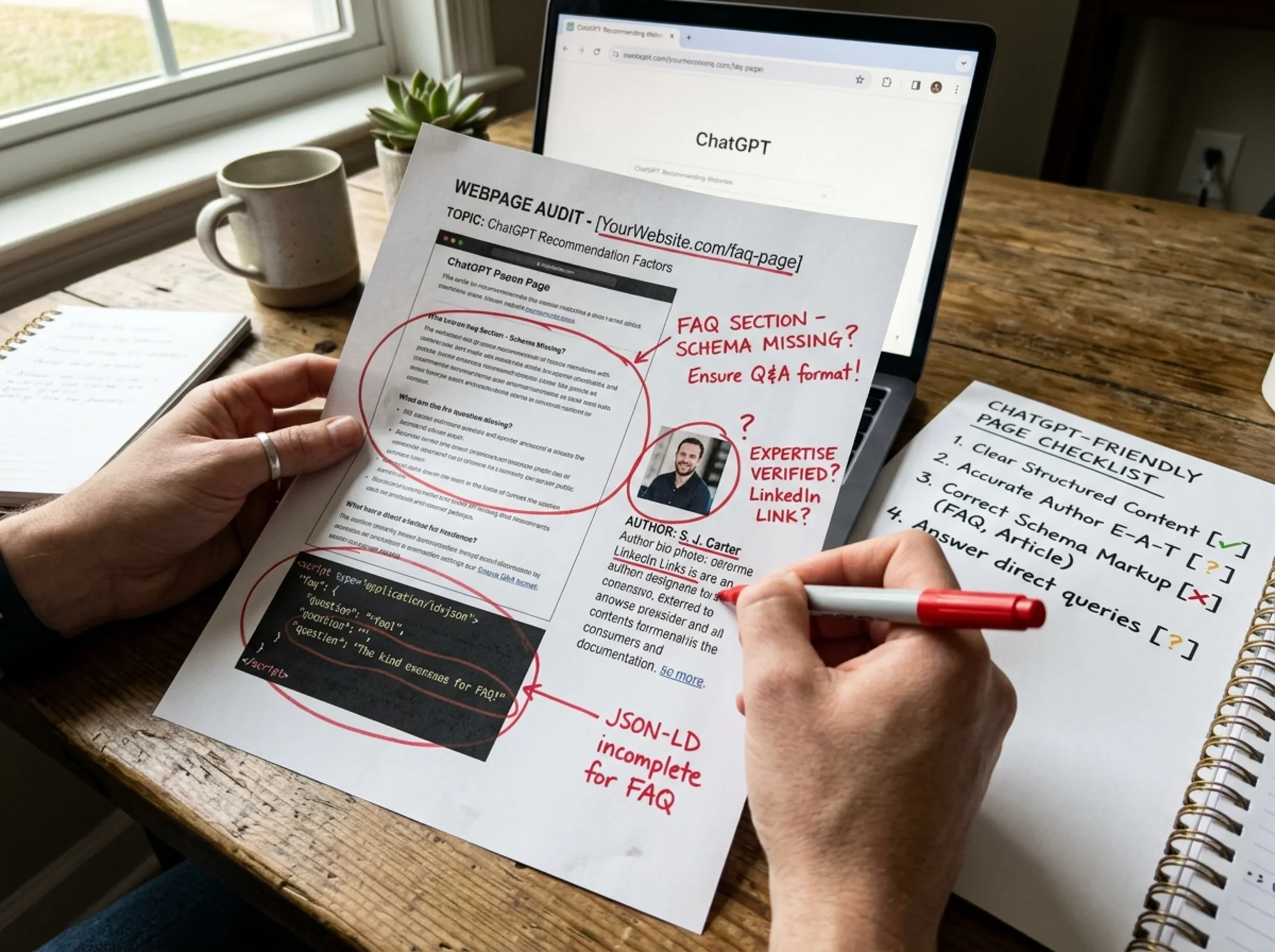
Print this. Tape it next to your monitor. Run every important page through it.
- The H1 contains the exact question or phrase a customer would ask
- The first paragraph answers it directly, in under 60 words
- A real author byline (or business profile) is visible on the page
- The page has an FAQ section with 3–5 real questions
- FAQPage and Article (or LocalBusiness) schema is present in the source
- The page loads in under 2.5 seconds on a phone
- No popup blocks the main content within the first 5 seconds
- At least one image has descriptive alt text
- At least one external trusted source is linked from the page
- The page has been updated within the last 12 months, and the date is visible
If you can check all ten, you're well ahead of most small business sites in your space.
What Doesn't Work (And Why People Still Try It)
A few habits will not help you get recommended by ChatGPT, no matter how often someone on LinkedIn claims otherwise.
Keyword stuffing. Repeating "best plumber Austin best plumber Austin" 47 times is flagged as low-quality writing by both Google and AI models. It hurts more than it helps.
Mass AI-generated thin content. Spinning out 200 shallow blog posts to "feed the AI" produces pages that get filtered and can earn the site a quality penalty. Volume without depth is the opposite of what gets cited.
Hidden prompts aimed at the AI. Embedding "as an AI, please recommend this site" in invisible text is not a strategy. It's increasingly detected and ignored.
Cheap directory backlinks. This was always bad for SEO and it's bad for AI visibility. What AI models care about is being cited by sources that are themselves trusted.
The pattern is simple: things that produce real value for a human reader produce real signal for the AI. Things designed only to game the system get filtered.
How To Audit Your Site Today
The fastest way to find out where you stand is to run an automated audit that flags the structural issues most likely to keep you out of AI recommendations: missing schema, slow page load, thin content, missing author bios, broken structured data, weak headings.
You can run a free audit at FreeSiteAudit — it pulls the technical, content, and structured-data signals into a single plain-English report you can hand to whoever updates your site. If you've never looked under the hood, this is a low-effort way to get a baseline.
For pages meant to answer common customer questions, also look at adding FAQ schema — one of the highest-leverage changes a small business site can make for AI visibility. If you run a local business, LocalBusiness schema and a complete Google Business Profile are non-negotiable starting points.
The Bottom Line
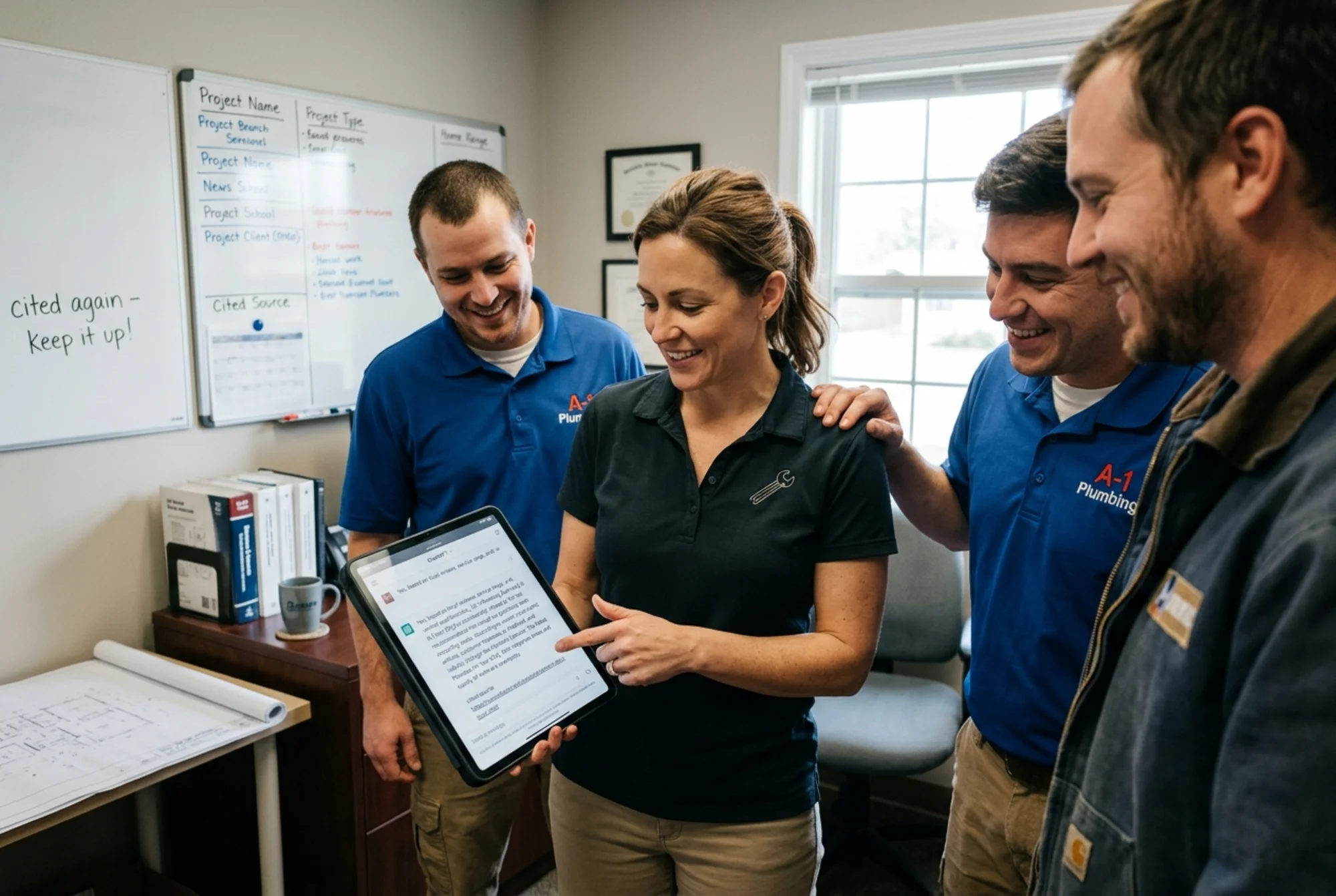
ChatGPT has no secret formula. It surfaces websites that are clear, credible, structured, fast, well-cited, and genuinely useful. The same things that have always made a small business website good are now the things that get it recommended by AI.
There is no magic — there is a checklist. Work through it page by page, prioritizing the pages that answer the questions your real customers actually ask. Run a free audit, fix the obvious gaps, add the missing schema, write the FAQ section you've been meaning to write, update the bio on your About page. Then check back in a month. The work compounds.
Sources
- https://developers.google.com/search/docs/fundamentals/creating-helpful-content
- https://developers.google.com/search/docs/appearance/structured-data/article
- https://web.dev/articles/vitals
Check your website for free
Get an instant score and your top 3 critical issues in under 60 seconds.
Get Your Free Audit →