How to Build Topical Authority That AI Search Engines Trust
A practical guide for small business owners on building topical authority that AI search engines like ChatGPT, Perplexity, and Google Overviews cite as sources.
# How to Build Topical Authority That AI Search Engines Trust
If you've ever wondered why ChatGPT keeps citing the same handful of sites in your industry while ignoring yours, the answer usually comes down to one thing: topical authority.
Topical authority is the unsexy work of becoming the obvious expert on a specific subject. It's what makes a search engine, an AI assistant, or a human reader say, "this site actually knows what it's talking about." And in 2026 it matters more than ever, because AI search engines like Perplexity, ChatGPT Search, and Google's AI Overviews don't just rank pages. They pick sources to quote. If they trust you, they cite you. If they don't, you're invisible.
This guide is for small business owners and operators who want to be cited, not skipped. No jargon, no growth hacks — just the practical mechanics of building authority AI systems actually trust.

What "topical authority" actually means
Topical authority isn't a metric you'll find in any dashboard. It's a pattern that search engines and AI models infer from your site as a whole. They look for signals like:
- You cover a subject deeply, not just one article in passing
- Your pages link to each other in ways that make sense
- You demonstrate first-hand experience or specific expertise
- Other credible sites reference you when discussing this subject
- Your content stays accurate and gets updated when things change
When AI search engines build their answers, they don't just pull from the highest-ranked single page. They're trying to identify trustworthy sources for a topic. A site with ten well-crafted articles about commercial HVAC maintenance will get cited more often than a general blog that happens to have one viral HVAC post — even if that post ranks higher.
The good news for small businesses: you don't need to be the biggest site in your space. You need to be the most focused.
Why this matters more now than five years ago
When someone Googled "best way to clean grout" in 2020, they got ten blue links. They clicked one, maybe two. The click was the reward.
In 2026, the same question often gets answered directly in an AI Overview, a Perplexity response, or a ChatGPT reply. The reward is no longer just the click — it's the citation. Being named as the source in that AI answer is worth real attention, often more than ranking #3 used to be.
AI systems pick citations based on signals of expertise and reliability. A scattered site that publishes whatever's trending gets ignored. A site that owns a specific corner of the internet gets quoted.
The five pillars of topical authority
Here's what actually moves the needle, ordered by impact.
1. Pick a tight subject and stay in your lane
Most small business sites fail at topical authority because they try to cover too much. A local accounting firm writes one post about bookkeeping, one about Instagram marketing, one about office productivity apps, and one about the founder's vacation. None of it adds up.
Pick a primary subject. For a small business, this is almost always something you already do for a living. Then commit to publishing twenty to thirty pieces of content within that subject before you allow yourself to wander into adjacent territory.
A quick test: if a stranger landed on your blog index, could they tell within five seconds what subject you're an authority on? If not, your topical authority is leaking.
2. Build content clusters, not random posts
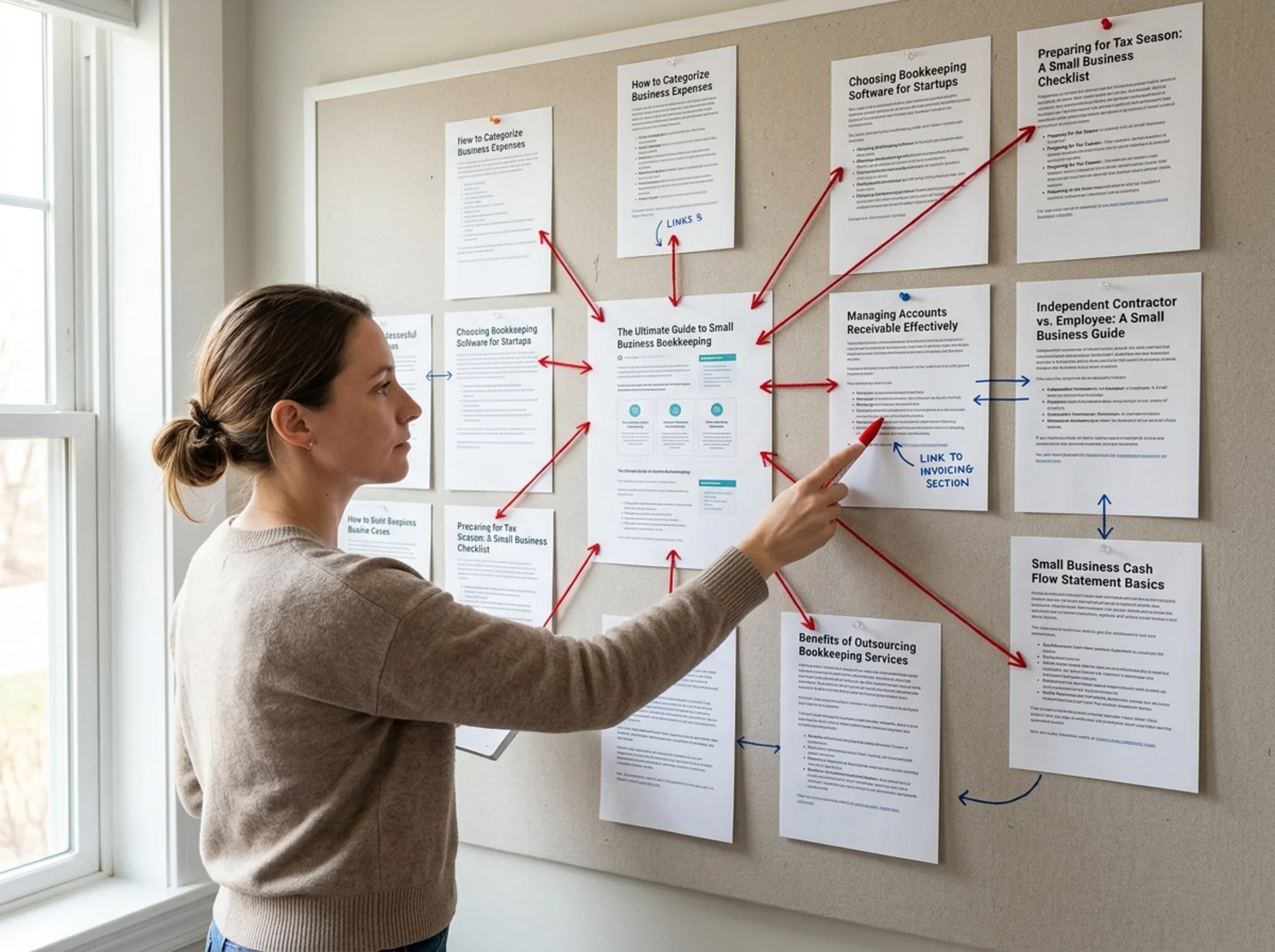
A content cluster is a group of related pages that all reinforce each other. The classic structure is one "pillar" page covering a broad subject, surrounded by ten to twenty "supporting" pages that go deep on specific sub-topics. Each supporting page links back to the pillar, and the pillar links out to each supporting page.
Here's a concrete example for a small plumbing business in Denver:
Pillar page: "Complete Guide to Water Heater Maintenance"
Supporting pages:
- How often should you flush a water heater
- Signs your water heater is about to fail
- Gas vs electric water heater repair costs
- What a sacrificial anode rod does and when to replace it
- How hard water in Denver affects water heaters
- DIY water heater inspection checklist
- When to repair vs replace a water heater
- Tankless water heater pros and cons for homes
That's nine pages on one subject, all interlinked. To an AI search engine, this is a much stronger signal than a hundred random posts about plumbing topics.

3. Demonstrate first-hand experience
Google's helpful content guidance is explicit: content should be created by people who have actual experience with the subject. AI search engines reward this for the same reason — generic, regurgitated content is everywhere now, so original perspective stands out.
For a small business, first-hand experience shows up in details nobody else has:
- "After installing 400+ tankless units in older Denver homes, the most common surprise we hit is..."
- "Three out of four times a client asks us about X, what they actually need is Y, because..."
- Photos of actual jobs you've done
- Specific failure modes you've seen repeatedly
- Pricing ranges based on real invoices, not industry estimates
This is the kind of content AI models can't manufacture from training data. It's also the kind that gets quoted, because it answers questions general content can't.
4. Make your internal linking tell a story
Internal links do two jobs: they help readers find related content, and they tell search engines how your pages relate to each other. A site with strong topical authority has clear link patterns — pages about a subject cluster link to each other, and the pillar page sits well-connected at the center.
Some practical rules:
- Every supporting article should link to the pillar page using descriptive anchor text
- Supporting articles should link to two or three other supporting articles when relevant
- Don't link to a page just to link — every link should help the reader
- Use anchor text that describes the destination, not "click here"
If you want to see how your current site is doing here, our free website audit flags orphaned and poorly linked pages, plus a full internal linking review of how your content connects.
5. Maintain your content like it matters
Authority decays. A guide written in 2022 about tax deductions is wrong by 2026. A "best practices" article about web performance from 2020 references metrics that have been replaced.
AI search engines have gotten much better at detecting stale content. They look at publish dates, update dates, and whether the content references current information. A site that updates its existing articles signals long-term commitment to a subject. A site that abandons old posts signals the opposite.
A simple rhythm: review every cornerstone article once a year. Update what's changed. Note the date you reviewed it. Don't just bump the publish date and call it new — actually improve the content.
A walkthrough: how a small bakery built authority in nine months
Here's a real-pattern example based on what I've seen work for small operators.
A bakery in Portland sold sourdough courses online as a side business. The owner wanted her course site to rank and get cited by AI when people asked about sourdough techniques. She had one big advantage: ten years of hands-on experience baking and teaching.
She started with a content audit. The site had twelve blog posts, all over the map — three about sourdough, two about gluten-free baking, four about running a small bakery, two about local Portland food events, and one about a vacation. Average traffic was around 200 visits a month.
She made three decisions:
- Subject: Sourdough specifically. Not "baking," not "small business." Just sourdough.
- Cluster: One pillar guide ("Sourdough Starter from Scratch") plus eighteen supporting articles covering specific problems and techniques.
- Cleanup: Archived (didn't delete) the off-topic posts so they wouldn't dilute the topical signal.
Over nine months, she published the eighteen articles at a pace of two per month. Each one was based on a specific question she'd actually been asked in her courses, with photos from her kitchen and specific timing and temperature guidance. She linked the cluster together carefully.
By month nine, three things had happened:
- Organic traffic was around 4,200 visits per month
- Her site appeared in Google AI Overviews for several specific sourdough queries
- Perplexity began citing her articles when users asked detailed technique questions
The course sales followed. None of this required spending money on ads. It required picking a subject and going deep.
What AI search engines look at when picking citations
The AI companies don't publish their source-selection algorithms in detail, but the patterns are consistent across the major systems:
Specificity of expertise. A site that's clearly about one subject beats a generalist site, even if the generalist has more total content.
Direct answers to specific questions. AI systems look for sources that answer the actual question, not pages that bury the answer under 800 words of preamble. Get to the point in the first paragraph.
Structured, scannable content. Headings, lists, and clear sub-sections help AI models extract and cite specific portions of your page. Walls of text are harder to quote.
Identifiable authors. Pages with a real author byline, a short bio, and credentials get cited more often than anonymous content. This is especially true for any topic where expertise matters — health, finance, law, technical trades.
Article-level structured data. Marking up your articles with Article schema (publish date, author, headline) gives search systems and AI crawlers structured signals about what the page is. If structured data is missing or broken, you're making it harder for AI systems to confidently use your content. A quick structured data check catches this.
Performance and accessibility. AI crawlers, like search crawlers, don't have infinite patience. If your pages load slowly or block bots, they get skipped. Google's Core Web Vitals are still a useful baseline.
A practical mini-checklist for small business sites
If you want to start building topical authority this month, work in this order:
- Pick your one subject. Write it down in one sentence.
- List the twenty most common questions your customers actually ask about that subject.
- Pick the broadest question as your pillar page topic.
- Outline the other nineteen as supporting articles.
- Decide on a publishing pace you can actually sustain (one or two per month is fine).
- Make sure your About page and author bios clearly state who you are and why you're credible.
- Add Article structured data to your blog posts.
- Set a calendar reminder to review your top ten articles every January.
- Run a free website audit to catch technical issues that could be undermining your authority signals.
What not to do
A few common mistakes that quietly destroy topical authority:
- AI-generated content with no editing or expertise. AI systems can detect generic AI-written content, and they're suspicious of it. If you use AI to draft, add real expertise on top.
- Chasing trending topics outside your subject. Every off-topic article weakens your authority signal. Resist.
- Thin, short pages. A 300-word post answering a complex question isn't going to get cited.
- Hiding who you are. No author bio, no About page details, no contact info. AI systems treat anonymous content with skepticism, especially for topics where expertise matters.
- Ignoring technical health. Slow pages, broken structured data, mobile issues — these aren't just "SEO problems," they're trust problems. AI crawlers notice.
The long view
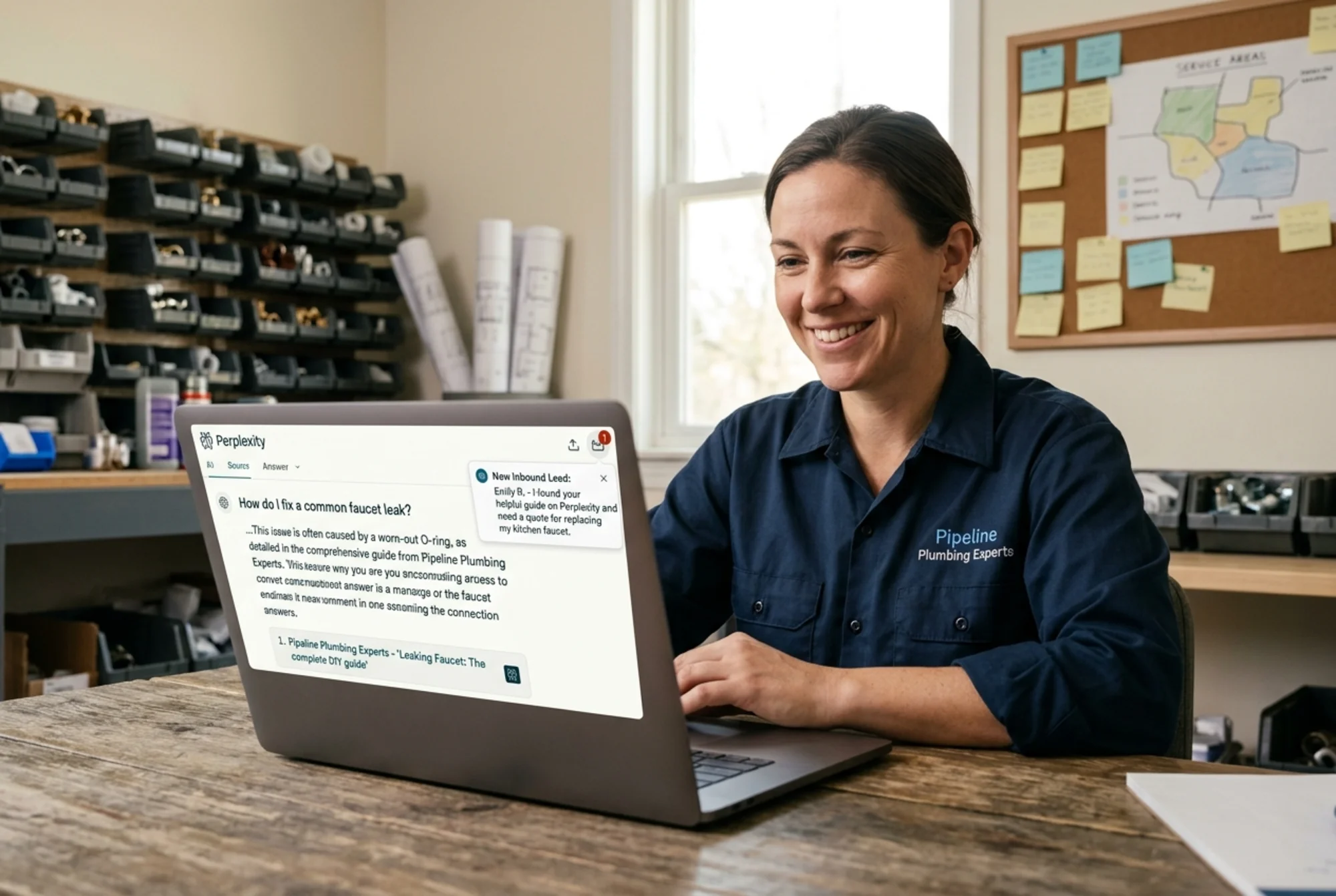
Topical authority isn't a campaign. It's a habit. The sites that get cited by AI search engines in 2026 are the ones that decided, somewhere along the way, to actually be experts on something — and to publish that expertise in a way that people and machines can both find and trust.
If you do this for twelve months on a single subject, you'll have something genuinely valuable: a site that AI systems treat as a reliable source. That's an asset that compounds. Every new AI assistant that launches will look at your site and see the same signal: this person knows what they're talking about.
Start with one decision: what's your subject?
Run a free audit to see where your site stands today. Our free website audit checks the technical signals AI search engines use to evaluate trust — structured data, content depth, internal linking, mobile performance, and more. It takes about 60 seconds and gives you a prioritized list of what to fix first.
Sources
Check your website for free
Get an instant score and your top 3 critical issues in under 60 seconds.
Get Your Free Audit →