Local Citation Audit: Finding and Fixing Inconsistencies That Hurt Local Rankings
Plain-English guide for local businesses to audit citations, spot NAP inconsistencies across Google, Yelp, and Apple Maps, and fix them in hours not weeks.
# Local Citation Audit: Finding and Fixing Inconsistencies That Hurt Local Rankings
If you run a local business, your name, address, and phone number (NAP) probably live in more places than you realize. Google Business Profile. Yelp. Apple Maps. Bing Places. The chamber of commerce site. That industry directory you forgot you signed up for in 2019. An old Facebook page someone set up before you took over.
When those listings disagree with each other, search engines lose confidence in your business. Customers get sent to the wrong door. The phone rings somewhere else. Your local pack rankings drift downward and you don't know why.
A citation audit fixes that. It's not glamorous work, but it's some of the highest-leverage cleanup a local business can do. This guide walks you through doing it yourself, in plain English, without buying expensive software.

What a citation actually is
A citation is any online mention of your business that includes some combination of your name, address, and phone number. Sometimes it includes your website URL and hours too. The mention doesn't have to link to your site. It just has to exist on a public page that Google can crawl.
Citations come in two flavors:
- Structured citations live in directories built specifically to list businesses: Google Business Profile, Yelp, Yellow Pages, Bing Places, industry sites like Avvo or Healthgrades, local chambers, BBB.
- Unstructured citations are mentions inside regular content: a local news article, a blog post about "best coffee shops in Austin," a sponsorship list on a nonprofit site.
Both matter, but structured citations are where most inconsistencies hide and where most of your audit time should go.
Why inconsistencies hurt
Google uses citations as one of several signals to verify that a business is real, located where it claims to be, and reachable through the contact info on its profile. When the signals agree, Google trusts them. When they conflict, Google has to pick a winner, and the winner is rarely the version you wanted.
Google's own guidance on helpful, reliable content emphasizes consistency and clarity as trust signals (see Sources). The same principle applies to your business data: a clean, consistent footprint reads as a legitimate, well-run operation.
Concrete things that go wrong when your citations conflict:
- Maps may show an outdated address. Customers drive to the wrong location.
- Click-to-call may dial a disconnected number. The lead is lost.
- Local pack rankings can soften because Google is less confident which version is canonical.
- Voice assistants may read incorrect hours.
- Review sites may split your reviews across two duplicate profiles.
None of these are theoretical. They show up constantly in real audits.
The four things you're checking
A citation audit isn't checking everything about a listing. It's checking four specific fields and looking for variations:
- Business name — exactly as it appears on your signage and Google Business Profile. No "LLC" on some, "Inc" on others, no random keywords stuffed in.
- Street address — including suite numbers, abbreviations (St vs Street, Ave vs Avenue), and directional indicators (N vs North).
- Phone number — formatting matters less than the actual digits. A tracking number on one listing and your real number on another is a real problem.
- Website URL — http vs https, www vs no-www, trailing slash, and whether the URL leads to a live page.
Hours, photos, categories, and descriptions are worth checking too, but they're a second pass. Start with NAP-W.
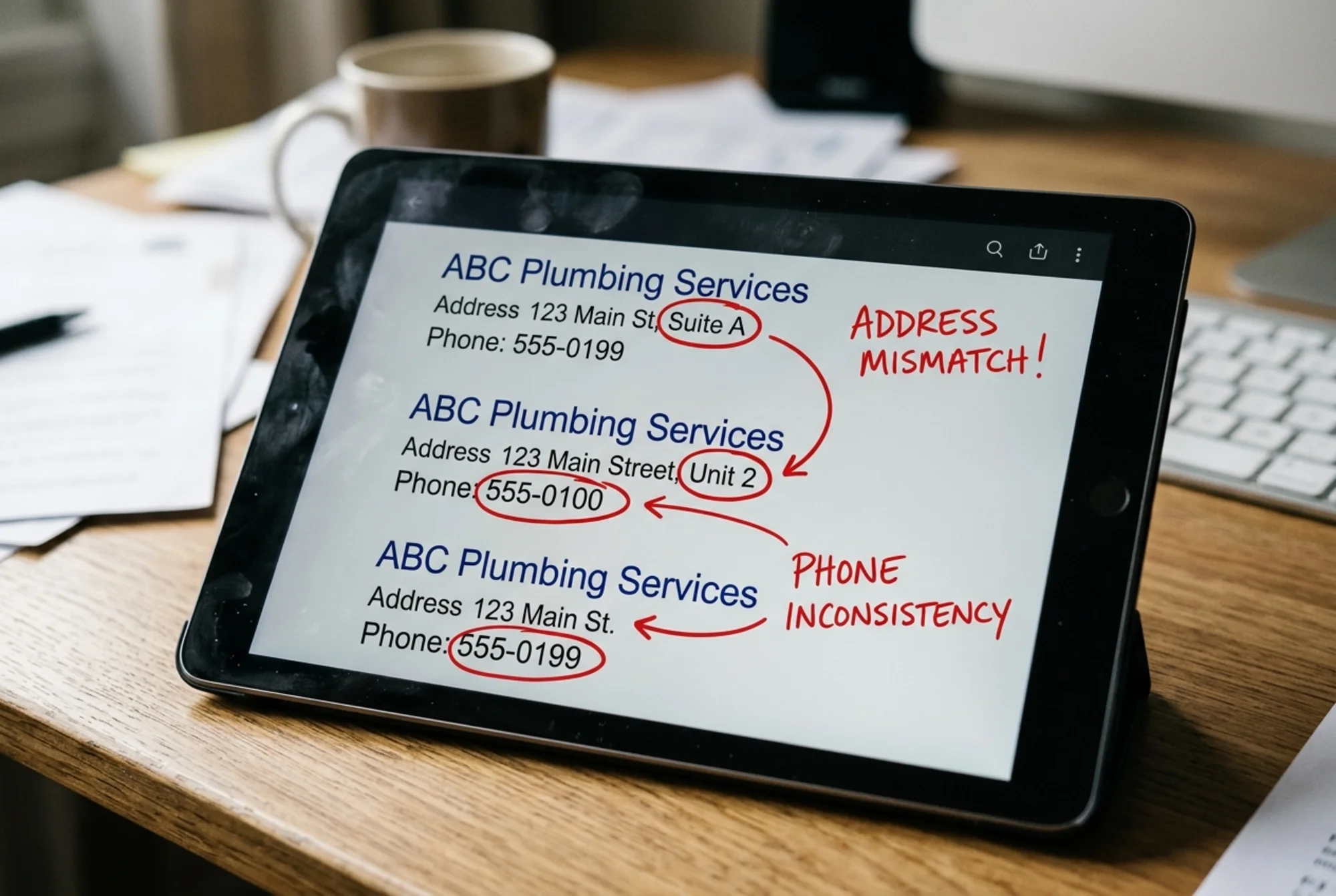
Step 1: Establish your source of truth
Before you go looking at listings, decide what the correct values are. Write them down. This is your canonical record and every citation gets measured against it.
A simple source-of-truth document looks like this:
- Name: Greenline Plumbing Services
- Address: 412 N Oak Street, Suite 2B, Springfield, IL 62701
- Phone: (217) 555-0142
- Website: https://greenlineplumbing.com
- Hours: Mon–Fri 7am–6pm, Sat 8am–2pm, Sun closed
- Primary category: Plumber
Pick one format for the address and stick to it everywhere. If you write "Suite 2B" on Google, don't write "#2B" on Yelp. If your phone is "(217) 555-0142," don't format it as "217.555.0142" anywhere else. Some platforms reformat automatically, but you should at least submit it the same way every time.
Step 2: Find where you're listed
You can't fix what you can't find. Three free ways to surface your existing citations:
Search variations of your business in Google. Try:
"Greenline Plumbing" Springfield"(217) 555-0142"(the exact phone number in quotes)"412 N Oak Street"(the exact address in quotes)"Greenline Plumbing" -site:greenlineplumbing.com(excludes your own site)
Each search will surface different listings. The phone and address searches are especially good at finding old or forgotten profiles.
Check the obvious directories directly. Search for your business by name and zip on:
- Google Business Profile
- Bing Places
- Apple Business Connect
- Yelp
- Yellow Pages
- Better Business Bureau
- Foursquare
- Your local chamber of commerce
- Two or three top directories for your industry (Avvo for lawyers, Healthgrades for medical, Houzz for home services)
Look at your competitors. Search a competitor's name the same way. Any directory they appear in is probably one you should be listed in too.
For each listing you find, record the URL, the values currently shown for the four fields, and any obvious issues. A simple spreadsheet works fine.
Step 3: Compare against your source of truth
Now you have a list of citations and a canonical record. Go through them one by one and flag mismatches.
The common patterns:
- Old phone number. You changed numbers two years ago and one directory still has the old one.
- Old address. You moved across town and three listings still point to the old building. This is the most damaging mistake because customers physically show up at the wrong place.
- Variation in name. "Greenline Plumbing" on one, "Greenline Plumbing Services LLC" on another, "Greenline Plumbing & Heating" on a third (maybe you used to offer heating).
- Duplicate listings. Two profiles for the same business on the same platform. This happens often on Google Business Profile and Yelp when someone other than you (a customer, a data aggregator, a former employee) created a listing.
- Broken URL. The website field points to a page that no longer exists, or to your old domain.
- Wrong category. You're listed as "Contractor" when you should be "Plumber."
Mark each issue with a severity: high, medium, low. A wrong phone on Google Business Profile is high. A typo in your description on a low-traffic directory is low. Fix high-severity issues first.

Step 4: A real walkthrough
Let's run through this with a fictional but typical case.
The business: Bayside Dental, a two-dentist practice in Tampa. They moved offices six months ago, from 1200 S Bayshore Drive to a new building at 1450 W Kennedy Boulevard. Bookings dropped after the move and the owner doesn't know why.
The source of truth:
- Name: Bayside Dental
- Address: 1450 W Kennedy Boulevard, Suite 300, Tampa, FL 33606
- Phone: (813) 555-0188
- Website: https://baysidedental.com
What the audit turns up:
- Google Business Profile: correct on all fields. Good.
- Yelp: old address, old phone (still rings to a number forwarded to a competitor who took over the building). High severity.
- Healthgrades: old address, correct phone. High severity.
- BBB: correct address, old phone. Medium severity.
- Facebook: correct everything, but a duplicate page exists with the old info. High severity.
- A local "best dentists in Tampa" blog post: old address linked. Low severity (email the author and ask for a correction).
- Apple Maps: old address. High severity (this is what iPhone users see).
- Two industry directories: never claimed, contain auto-generated old data. Medium severity.
The fix order:
- Update Apple Maps and Yelp the same day. iPhone users and Yelp searchers are sending leads to the wrong building.
- Update Healthgrades and the duplicate Facebook page.
- Claim the two industry directories and update them.
- Update BBB.
- Email the blog author about the old address.
Within a week, the practice has consistent NAP across every meaningful listing. Within a month, calls and confirmed appointments start trending back up. The audit itself took about four hours of focused work spread across two sittings.
This is the pattern: a handful of high-impact fixes account for almost all the recovery. You don't need to fix two hundred citations. You need to fix the right twenty.
Step 5: Fix, then verify
Updating a listing isn't always instant. Some directories review submissions before publishing. Some pull data from third-party aggregators (Data Axle, Foursquare) that need to be updated upstream. Set a reminder to recheck each fixed listing two weeks later and confirm the change actually took.
When you encounter a duplicate listing:
- On Google Business Profile, request removal through the profile's support flow. Don't just leave the duplicate sitting.
- On Yelp, use the "Report a problem" link on the duplicate page.
- On Facebook, merge pages through Facebook's page management tools.
When you encounter a listing you can't claim because someone else claimed it (an old owner, a former employee, an agency you stopped working with), every major platform has a reclaim process. It takes longer but it's worth doing.
Common mistakes to avoid
- Stuffing keywords into your business name. "Greenline Plumbing - Emergency 24/7 Plumber Springfield" is a violation of Google's guidelines and risks suspension. Use your real name.
- Using a tracking number as your primary phone. Tracking numbers are useful for measuring channel performance, but they create NAP inconsistency when they don't match what's on your website and other listings. If you must use them, do so in a controlled way (e.g., only on Google Business Profile with a forwarding setup) and accept the tradeoff.
- Using a virtual office or coworking address. Google has gotten aggressive about suspending listings that share an address with many other businesses. If you don't have a real, staffed location, consider whether a service-area business setup makes more sense.
- Ignoring small directories. Even low-traffic directories feed data aggregators, which then push out to other sites. A bad value in one obscure directory can re-infect listings you already fixed.
- Doing it once and forgetting. Citations drift. Aggregators re-import old data. New directories appear. Recheck your high-priority listings every six months.

A mini-checklist you can save
Use this on every citation you check:
- [ ] Business name matches source of truth exactly
- [ ] Street address matches, including suite and abbreviations
- [ ] Phone number matches the digits used elsewhere
- [ ] Website URL is correct and loads
- [ ] Primary category is the most accurate option available
- [ ] Hours are current
- [ ] No duplicate listing exists for this business on this platform
- [ ] Listing is claimed by you, not a third party
If a citation passes all eight, move on. If it fails any, fix it and recheck in two weeks.
How this connects to the rest of your local SEO
Citation consistency is part of a larger picture. A clean citation footprint won't rescue a slow website, a thin Google Business Profile with no photos, or a site with no local landing pages. But a strong website is partially wasted if your NAP is scrambled across the web.
Page experience matters here too. Google's Core Web Vitals (see Sources) measure how fast and stable your pages feel to real users. A local searcher who taps your listing and waits four seconds for the page to load is a searcher who already bounced. Make sure the website you're listing in every directory actually delivers when someone arrives.
If you want a fast read on whether the website side of your local presence is in shape, run a free website audit with FreeSiteAudit. It checks the technical and content basics — load speed, mobile friendliness, structured data, metadata — in a few minutes. Combine that with the citation cleanup above and you'll have covered the two biggest controllable inputs to local search performance.
For a deeper look at NAP-specific fixes once you've found the inconsistencies, see our guide on NAP consistency. And if you want patterns specific to your sector, our local business resources cover common scenarios for restaurants, contractors, medical practices, and service businesses.
What to do next
If you've never done this before, block out a half day this week. Build your source-of-truth document first. Then run the searches in Step 2 and collect everything into a spreadsheet. Then start fixing, high severity first.
You won't finish in one sitting and that's fine. The goal isn't perfection across two hundred directories. The goal is consistent, correct data on the listings that actually drive calls and visits to your business. Twenty good fixes beat two hundred half-finished ones.
Once it's clean, put a recurring reminder on your calendar for six months out. A short recheck then will catch drift before it costs you.
Sources
- Google Search Central: Creating helpful, reliable, people-first content — https://developers.google.com/search/docs/fundamentals/creating-helpful-content
- web.dev: Core Web Vitals — https://web.dev/articles/vitals
Check your website for free
Get an instant score and your top 3 critical issues in under 60 seconds.
Get Your Free Audit →