Optimizing for Perplexity AI: What Makes a Good Source
Learn how Perplexity AI picks sources and what to change on your small business site to get cited — clear answers, named authors, clean HTML, fast pages.
# Optimizing for Perplexity AI: What Makes a Good Source
Perplexity AI doesn't work like Google. It doesn't show ten blue links and let you pick. It reads the web, writes an answer, and lists the handful of sources it pulled from — usually three to six citations per response.
If your site is one of those citations, you get traffic, trust, and a free endorsement. If it isn't, you're invisible. There's no "page 2" of Perplexity.
So the question for any small business owner is simple: what makes Perplexity pick your page over someone else's?
This guide walks through that in plain English — no theories about AI internals, just the practical patterns that show up over and over when you look at which pages get cited.
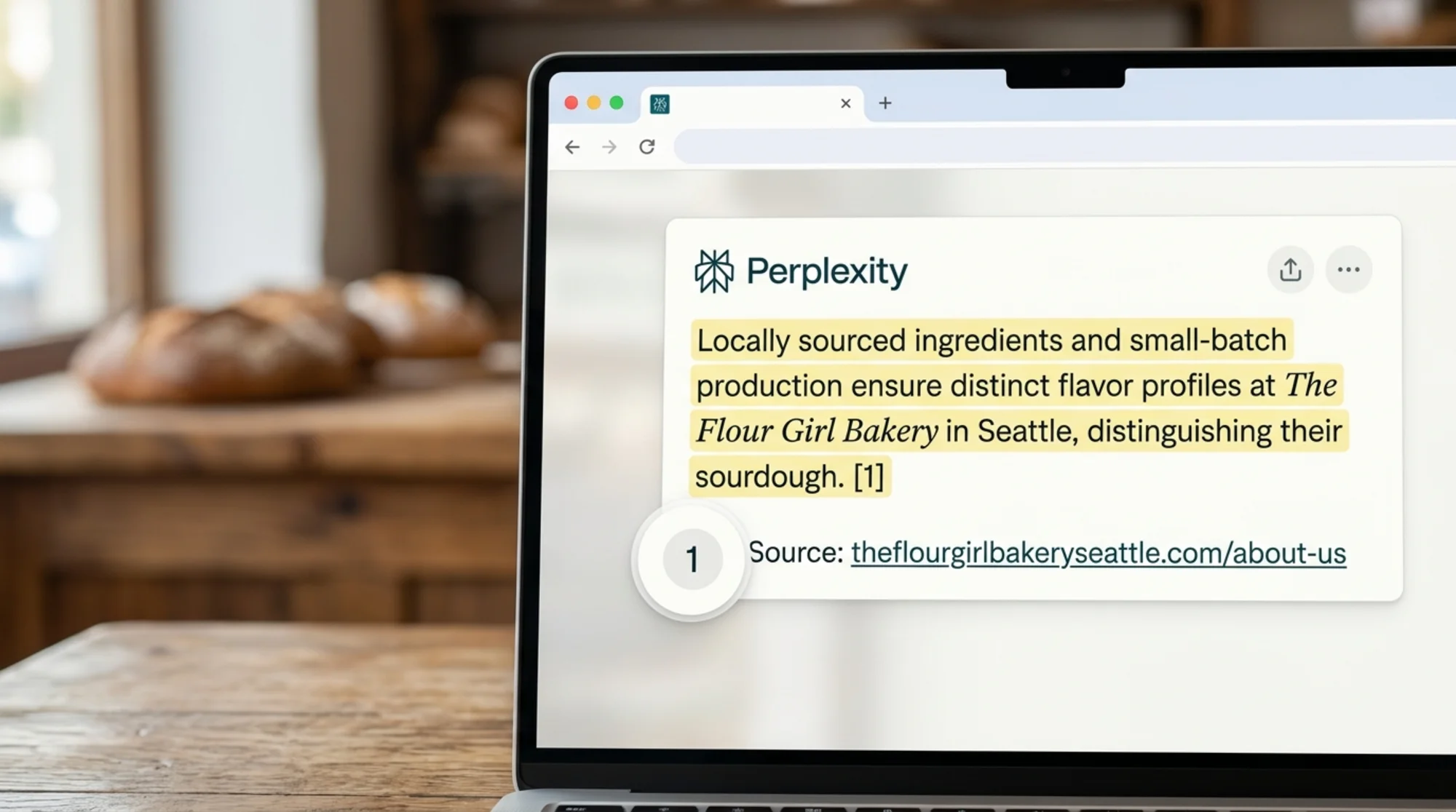
How Perplexity actually picks sources
Perplexity is a "retrieval-augmented" answer engine. When someone asks it a question, it:
- Searches the web (its own index plus signals from Google and Bing).
- Pulls a handful of pages it thinks contain the answer.
- Reads those pages.
- Writes a short answer in its own words.
- Cites the pages it actually used.
That last step matters. Perplexity only cites pages it could extract a clear answer from. So your goal isn't just to rank — it's to be quotable.
A page that ranks #1 on Google but buries the answer under 800 words of brand storytelling will often get skipped. A page that ranks #4 but answers the exact question in two clean sentences will get the citation.
That single insight changes how you write.
What "a good source" looks like to Perplexity
Look at the pages Perplexity tends to cite for small business and local queries and a pattern shows up. Good sources have most of these traits:
- A clear, specific answer near the top of the page
- A real author with a real name and some credentials or experience
- A visible published or updated date
- Facts written as facts, not as marketing claims
- Original information — numbers, examples, quotes, screenshots — that doesn't exist elsewhere
- Clean HTML that's easy for a crawler to read
- A topic the page actually focuses on, not a generic "everything" page
None of this is about keyword stuffing or backlink schemes. It's editorial quality with technical hygiene on top. Google's own helpful content guidance points the same way: write for people, demonstrate first-hand experience, and make the page about one thing.
The seven things to fix this week
If you want Perplexity to start citing you, here's a practical order of operations. Most small business sites can knock out all seven in a weekend.
1. Answer the question in the first 60 words
Perplexity reads top-down. The model is essentially asking, "Where is the answer to the user's question?" If the first thing it sees is a hero banner with "Welcome to our family bakery, est. 2014," it has to keep scanning — and the longer it scans, the more likely it gives up and picks a different page.
Open your most important blog posts and service pages. Look at the first paragraph. Ask: if a customer asked this exact question out loud, would the first sentence answer it? If not, rewrite the opening.
Before:
> Choosing the right wedding photographer is one of the most important decisions you'll make as a couple. There are so many factors to consider, and we know it can feel overwhelming...
After:
> A wedding photographer in Austin typically costs $2,800–$5,500 for full-day coverage, depending on experience and deliverables. Here's how to choose one without overpaying.
The "after" version gives Perplexity something quotable in the first line.
2. Use real questions as your H2 headings
Perplexity matches user questions to text on the page. Vague headings like "Our Approach" or "Why It Matters" give the model nothing to match against. Use headings that look like questions a real person would type:
- How much does a website audit cost for a small business?
- What's the difference between SEO and an audit?
- Do I need a website audit if I just launched?
Answer each one in two to four short sentences directly below the heading. That format is almost identical to what the model is trying to produce in its own answer — which makes your page extremely easy to cite.
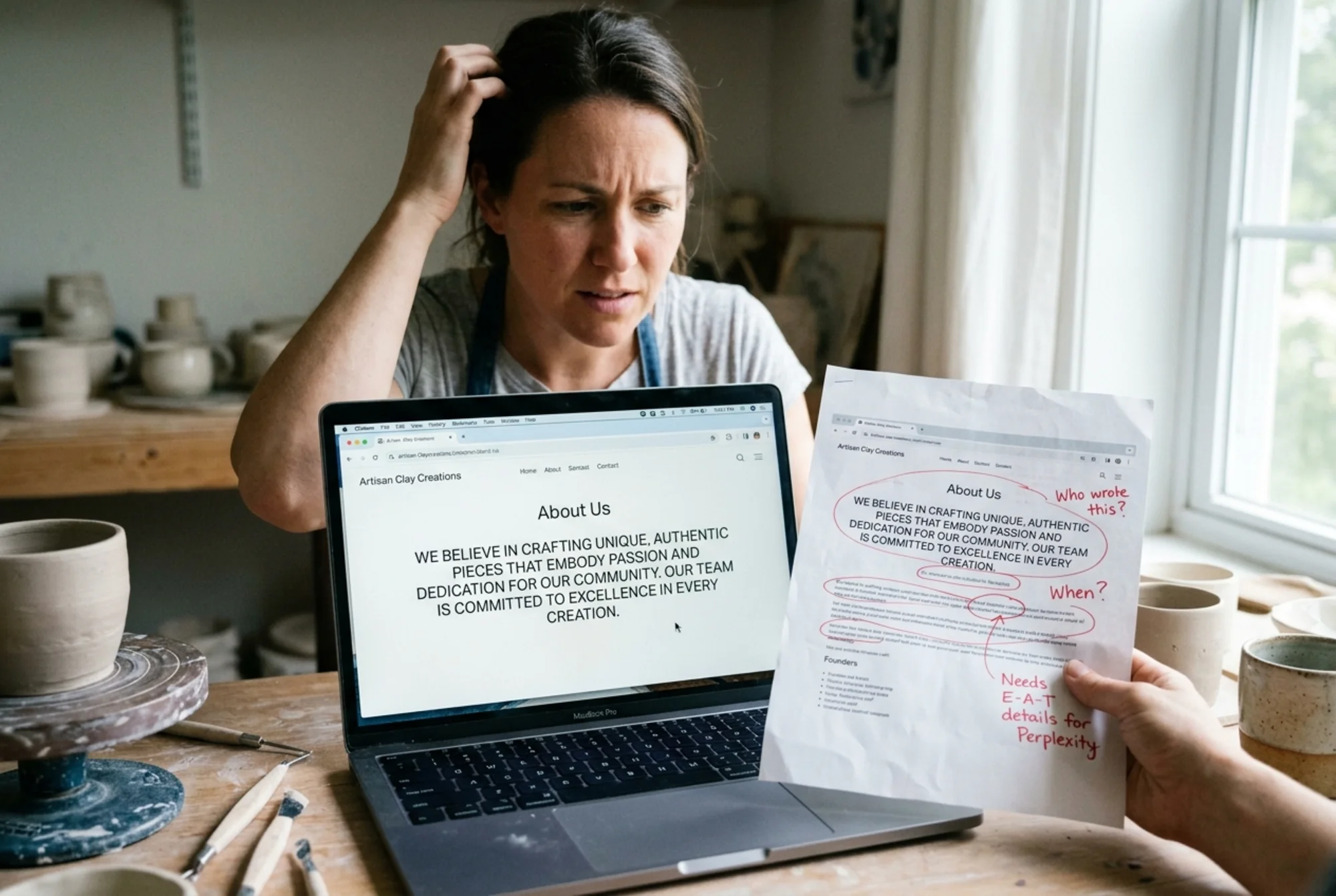
3. Show who wrote it
Anonymous content is a hard sell for any answer engine. Perplexity favors sources where a human is clearly accountable for what's on the page.
For each main piece of content, add:
- An author name — a real person, not "Admin" or your brand name
- A one-sentence bio that mentions relevant experience
- A link to the author's LinkedIn or another bio page
This isn't about gaming a system. It's the same principle behind a doctor signing a medical article or a chef being named on a recipe. "Trust me, I'm a website" doesn't fly anymore.
4. Publish original information
Perplexity is built to summarize. If your page is itself a summary of other people's content, the model has no reason to cite you — it'll just cite the original sources you copied from.
Original information for a small business looks like:
- Your own pricing (with actual numbers, not "contact us for a quote")
- A case study with specific results from a real client
- A photo you took
- A screenshot of a tool you use
- A customer quote
- Data from your own bookings, sales, or operations
- A walkthrough of something you've actually done
A plumber writing "5 reasons your faucet leaks" by paraphrasing Home Depot's article won't get cited. The same plumber writing "I've fixed 400 leaky faucets in Portland — here are the 3 causes I actually see" will.
5. Add a visible date
Perplexity is biased toward fresh, dated content for anything where recency matters — pricing, regulations, tools, software, "best of" lists, local information.
Add a visible "Published" or "Updated" date to every page where it makes sense. Not just in the metadata — visible to a human reader, near the title. If you update the post later, update the date. Don't fake it, but don't hide it either.
6. Use clean, structured HTML
This is the technical bit. Perplexity (and every other AI crawler) reads your raw HTML, not the visual layout. If your "list of services" is actually a stack of styled Make sure your pages use: Article schema is particularly useful because it tells crawlers exactly who wrote the piece, when it was published, and what it's about — the same things Perplexity wants to know to decide whether to cite you. If you're not sure what your page looks like to a crawler, you can run a free website audit to check the structured data and heading sections. A page that won't load or that hides its content behind JavaScript the crawler can't run won't get cited — the model never saw it. The basics: Core Web Vitals aren't only a Google ranking factor — they're a baseline signal that your site is technically healthy. If your page takes nine seconds to load, that reads as low quality regardless of what's on it. Let's make this concrete. Imagine you run a three-person CPA firm in Denver. Your goal: when someone asks Perplexity "how much does a small business tax return cost in Denver," you want your firm to be one of the citations. Here's what a high-citation-probability page looks like for that query: URL: Title: Small Business Tax Return Costs in Denver (2026 Pricing Guide) First paragraph: > A small business tax return in Denver typically costs $450–$1,800 in 2026, depending on entity type, transaction volume, and whether bookkeeping is included. Below is a breakdown of what drives those numbers, based on prices we've quoted across 200+ engagements this year. Headings on the page (each followed by a short, direct answer): Other elements: That page hits almost every signal Perplexity cares about: specific answer up front, real numbers, real author, recent date, original data, clean structure. It will likely get cited even if it ranks #6 on Google for the query, because most higher-ranked pages will be national listicles with vague price ranges and no author. A few patterns show up repeatedly on small business sites that should be cited but aren't: You don't need to fix every one on every page. Start with your top five pages by traffic or commercial intent, and clean those up first. Before you publish or update a page, run it through this: If you can tick all eight, you've done more than 90% of small business sites on the topic. Good news: optimizing for Perplexity isn't a separate discipline from optimizing for Google. Almost everything on the checklist above is also what Google's helpful content guidance asks for, and what's been in technical SEO best practices for years. What's different is the weighting. In traditional SEO you could sometimes win with backlinks and brand even if the content was mediocre. For AI citations, the content itself has to be quotable. There's no shortcut — the model is literally reading the words and deciding whether they're useful. Sites that get cited well by Perplexity also tend to do better on Google AI Overviews, ChatGPT search, and Bing Copilot. The signals overlap heavily. A coffee shop owner on a tablet reading a Perplexity answer that cites her shop's pricing guide as source [1], with a small notification showing a new customer inquiry from the citation click If you've made it this far, you have a working understanding of what Perplexity wants. The next step is the boring one: actually audit your current pages against the checklist and fix them. The fastest way to find out where you stand technically is to run a free website audit on your most important pages. It'll flag missing structured data, slow load times, weak headings, thin content, and the other technical issues that quietly kill your chances of being cited. Fix those, then work through the editorial checklist above page by page. You don't need to rewrite your whole site. Pick the five pages that would matter most if a potential customer landed on them from a Perplexity answer, and start there. One good citation from a relevant query is worth more than another month of grinding on social media. The web is becoming a place where AI engines decide what gets seen. Small businesses that take twenty hours to make their content quotable now will look, in two years, like the businesses that took SEO seriously in 2010. Get an instant score and your top 3 critical issues in under 60 seconds., , headings in order elements for tabular data
Article or BlogPosting) on blog posts7. Make the page fast and crawlable
robots.txt (PerplexityBot is a documented user-agent)sitemap.xmlA walkthrough: a local accountant who wants to get cited
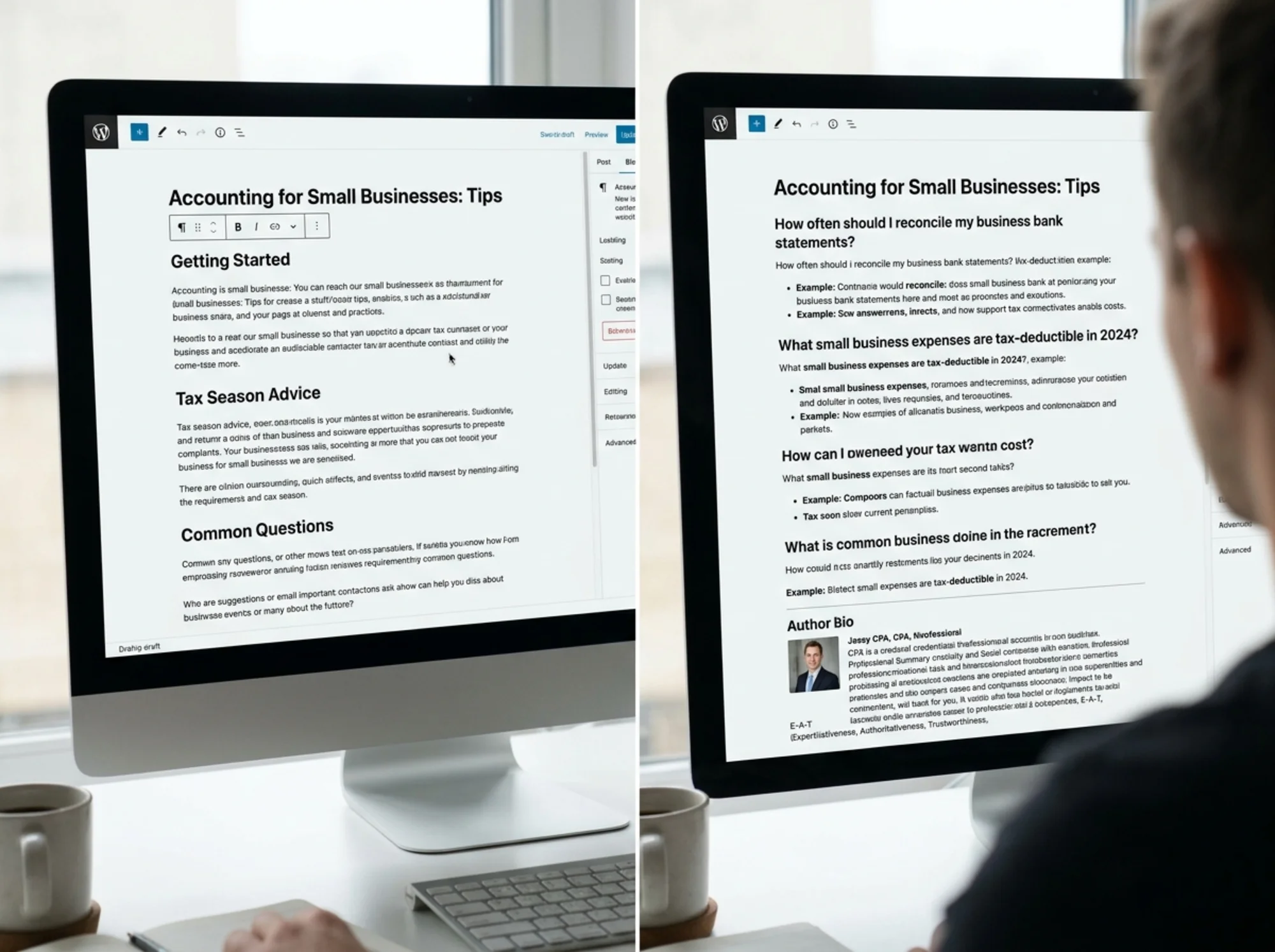
/blog/small-business-tax-return-cost-denver, not an image
Common mistakes that kill your citation chances
A quick self-audit checklist
How this fits with regular SEO
What to do next
Sources
Check your website for free