Review Velocity: How Often You Need New Reviews to Rank in Local Search
A plain-English guide to local review velocity: realistic monthly targets by industry, a 1-3-7 workflow, and a practical checklist for steady review flow.
# Review Velocity: How Often You Need New Reviews to Rank in Local Search
If a competitor with fewer total reviews keeps outranking you on Google Maps, the answer is usually one word: velocity.
Review velocity is how often you get new reviews over time. It's the difference between a business that collected 80 reviews three years ago and forgot about it, and one that picks up two or three fresh reviews every week. Google treats those two very differently, and so do customers.
This post breaks down what review velocity actually means, how much you realistically need, and a practical workflow you can put in place this week.

What review velocity actually means
Velocity is a rate. It answers the question: how many new reviews is this business getting per week or per month, right now?
Two businesses can have the same total star count and look identical at first glance:
- Business A: 142 reviews, 4.7 stars, most recent review eight months ago.
- Business B: 98 reviews, 4.6 stars, most recent review four days ago, with new ones every week.
To a customer, Business B looks alive. To Google's local ranking signals, Business B looks like a place where real people are still showing up, paying money, and having experiences worth talking about. Business A looks like it might have closed.
Google has never published an exact formula for review recency, but it has stated repeatedly that signals of activity, freshness, and real human engagement matter for both web and local results. The pattern in the wild matches: businesses with steady new review flow tend to hold or improve their Maps position, while those with stale review histories drift downward — especially when nearby competitors keep collecting.
Why "more reviews" is the wrong goal
A common mistake is treating reviews like a one-time campaign. You ask everyone you've ever served, get a burst of 30 in a week, then nothing.
That causes two problems:
- Burst patterns look suspicious. Twenty reviews in seven days followed by six months of silence reads as a coordinated push, not organic customer behavior. Google's spam systems flag unnatural patterns.
- You lose the freshness signal. The day after your burst, your "most recent review" date starts aging. By month four, your profile looks just as stale as before.
The goal isn't a number. The goal is a steady drip that matches the natural rhythm of your business.
How much velocity do you actually need?
There is no universal number, but there is a useful benchmark: enough to stay ahead of the most active competitor in your map pack.
Open Google Maps. Search the term you want to rank for. Look at the top three results. For each, check:
- The date of the most recent review.
- How many reviews appeared in the last 30 days.
- How many in the last 90 days.
That gives you a target. If the top three local plumbers in your city each get 4–6 new reviews per month, you need to be in that range, ideally a bit above. If the top café in your neighborhood gets 15 a month, three a month won't cut it.
As a rough starting point:
- Service businesses (plumbers, electricians, lawyers, dentists): 2–4 new reviews per month is a reasonable floor; 6–10 is competitive in busy metros.
- Restaurants, cafés, retail with foot traffic: 8–15 per month is typical for healthy independents; 25+ for the strongest players.
- B2B and niche services: 1–2 per month, but with specific reviews that mention the actual service.
Whatever the number, consistency matters more than magnitude.

The signals Google actually cares about
Beyond raw count and recency, here's what tends to move the needle:
- Recency. A review from yesterday signals an active business.
- Steady cadence. A predictable trickle (one or two a week) reads as organic.
- Review content. Reviews that mention your service, your city, or specific products help Google understand what you do. "Great experience" tells Google nothing. "Replaced our water heater in Brookline same-day" tells Google you're a Brookline plumber who does emergency water heater work.
- Response rate. Replying to all (or nearly all) reviews is a positive signal and also nudges more customers to leave their own — they see you're paying attention.
- Source diversity. Most weight comes from Google reviews for local pack ranking, but reviews on Yelp, Facebook, and industry sites (Houzz, Avvo, TripAdvisor) reinforce trust and feed other discovery surfaces.
The opposite of these — clustered bursts, generic one-liners, no owner responses, reviews concentrated on a single platform — all weaken the picture.
A simple framework: the 1-3-7 rule
A workflow that fits into a small business looks like this:
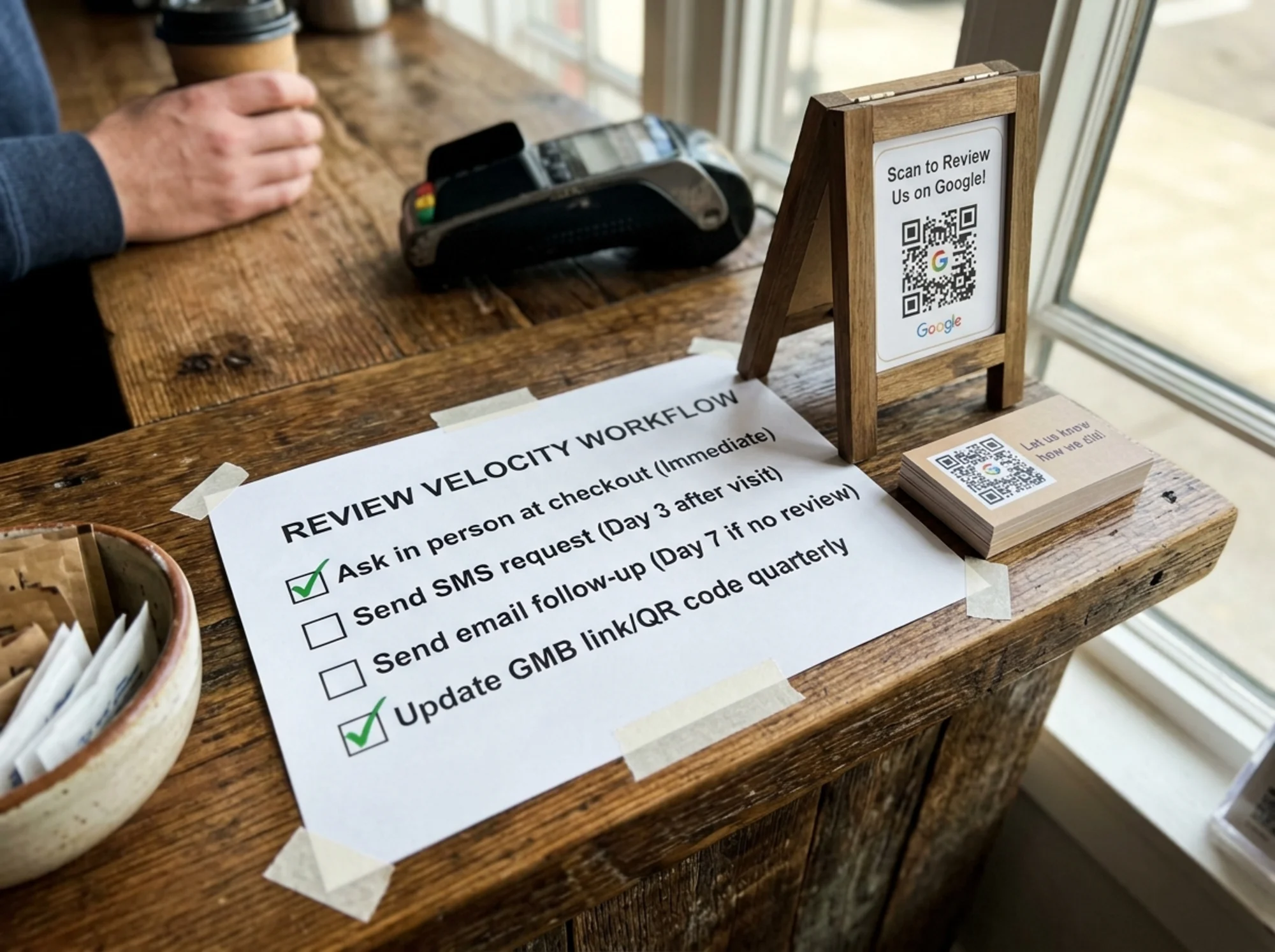
- Day 1 (point of sale). The customer pays or the service ends. You ask in person: "If you have a minute, a quick Google review would mean a lot. Here's a card with the link."
- Day 3 (follow-up). A short text or email with the direct review link. One sentence.
- Day 7 (final nudge). One more friendly message, only if they haven't reviewed yet.
Three touches, one short window, then you stop. Anything beyond day seven and the customer has forgotten the experience anyway.
If you serve 40 customers a month and 8% leave a review, that's three reviews. Serve 200 a month at 5% and that's 10. The math is forgiving when the workflow is consistent.
A walkthrough: one café, six months
A small independent café in a competitive part of town has 64 Google reviews, 4.5 stars, and their last review was three months ago. They rank at position six on Maps for "coffee shop near me." Two competitors above them have similar review counts but a fresh review every week.
Month 1. Cards with a QR code linking to the Google review form. Baristas hand one out with every order over $8 and say a single sentence: "If you liked it, a Google review really helps a small place like ours." Result: 6 new reviews.
Month 2. A small sign at the pickup counter: "We're a family-run café — your review helps neighbors find us." The owner starts replying to every review within 48 hours. Result: 9 new reviews.
Month 3. A Tuesday-and-Friday rhythm — 10 minutes twice a week to reply to recent reviews and restock cards. Result: 11 new reviews.
Month 4. A loyalty-app message to repeat customers includes the review link. Result: 14 new reviews.
Months 5 and 6. The system runs itself. The café averages 12 new reviews per month. By the end of month six, they've moved to position two on Maps, and click-throughs from the listing have roughly doubled.
The specific numbers vary by business. The structure is what travels: small consistent actions, baked into the daily workflow, sustained long enough for Google to see a clear pattern.
Mistakes that kill velocity (and rankings)
- Buying reviews. Google's systems are good at spotting this. The damage from a takedown is far worse than any short-term lift.
- Incentivizing reviews. Offering a discount, free item, or giveaway entry in exchange for a review violates Google's and Yelp's policies. Both will remove the reviews and can suspend listings.
- Review gating. Asking only happy customers — filtering who you invite to leave a public review based on how they rate you privately — is explicitly prohibited by Google. Ask everyone.
- Templated review text. If five reviews use suspiciously similar wording, Google notices. Let people write what they want.
- Ignoring negative reviews. A thoughtful, non-defensive response to a one-star review often helps your trust signals more than the review hurts.
- Email-only asks. Open rates are low. In-person and SMS convert much better.
A practical checklist you can use this week
- [ ] Note the date of your most recent Google review.
- [ ] Count reviews from the last 30, 60, and 90 days.
- [ ] Do the same for your top three local competitors.
- [ ] Identify one moment in your customer flow where asking feels natural.
- [ ] Create a direct review link (Google provides a short link in your Business Profile dashboard).
- [ ] Print 20 cards with that link, or set up an SMS template if you have customer phone numbers.
- [ ] Reply to every review from the last 90 days, even old ones.
- [ ] Block 15 minutes on Tuesday and Friday for review management — asking, replying, restocking cards.
- [ ] Pick a realistic monthly target based on your competitors.
- [ ] Recheck velocity in 30 days.
If you'd rather start with a full audit of your local SEO setup — including whether your Business Profile, website, and review profile are reinforcing each other — run a free audit with FreeSiteAudit. It looks at the technical and content signals around your local presence, not just reviews in isolation.
Why your website still matters for review velocity
Reviews don't live in a vacuum. A few website-side things directly affect whether new reviews translate into rankings:
- NAP consistency. Your Google Business Profile listing must match your website's name, address, and phone exactly. If they drift, Google has less confidence the reviews belong to the business it's ranking.
- Page experience. When a user clicks through from a great review on Maps to a slow, broken-looking website, you lose the trust the review just built. Core Web Vitals (LCP, INP, CLS) are a real ranking input, especially for mobile local search.
- Structured data. Marking up your business with appropriate schema gives Google more confidence to surface your reviews and ratings in rich results.
- Content alignment. If your reviews mention "emergency drain cleaning Brookline" but your website never uses those words, you're leaving the connection on the table. Google's helpful content guidance is clear that pages should reflect the real-world topics and audiences they serve.
If your profile and website don't tell the same story, fresh reviews work harder than they need to. Our Google Business Profile fixes guide walks through the most common mismatches, and the local services playbook covers what to prioritize first.
The honest takeaway
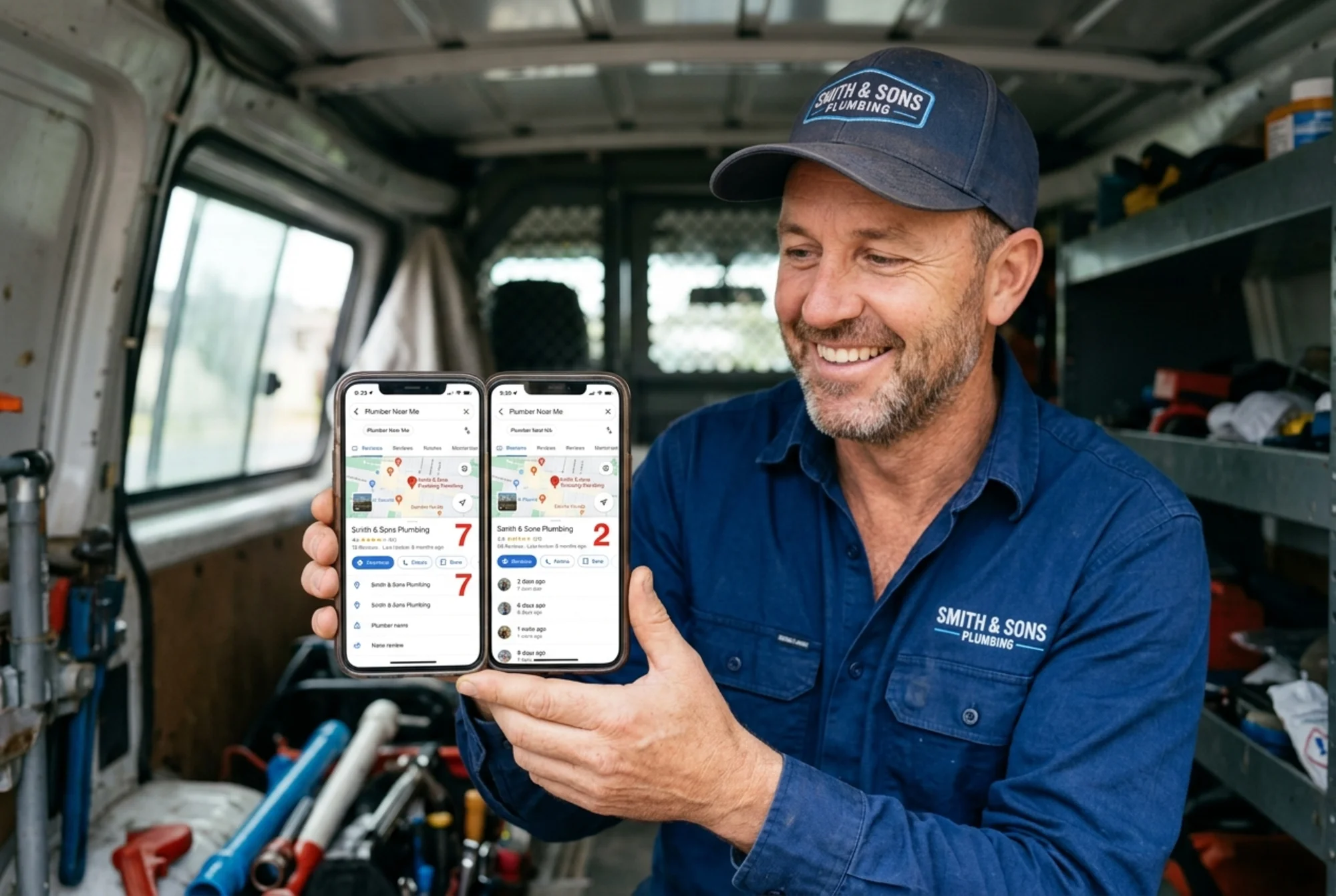
You don't need a viral campaign. You don't need 500 reviews. You need a number slightly higher than your most active competitor's monthly count, sustained for several months, with thoughtful owner responses and a website that lives up to what the reviews promise.
Most small businesses can hit a healthy review velocity with fifteen minutes a week and one clear point in the customer flow where the ask happens. The technical setup takes one afternoon. The discipline to keep at it is the actual work.
If you serve real customers and do real work, the reviews are out there waiting to be asked for. The businesses that ask consistently, win consistently.
Run a free audit at FreeSiteAudit to see how your site is currently set up to support your review and local ranking efforts — and what specifically to fix first.
Sources
- Google Search Central — Creating helpful, reliable, people-first content: https://developers.google.com/search/docs/fundamentals/creating-helpful-content
- Google Search Central — Article structured data: https://developers.google.com/search/docs/appearance/structured-data/article
- web.dev — Core Web Vitals: https://web.dev/articles/vitals
Check your website for free
Get an instant score and your top 3 critical issues in under 60 seconds.
Get Your Free Audit →