Website Audit for Veterinarians and Pet Care Businesses: A Practical Guide
A plain-English guide to auditing your veterinary or pet care website so anxious pet owners can find you, trust you, and book appointments without friction.
# Website Audit for Veterinarians and Pet Care Businesses: A Practical Guide
Most pet owners find their vet the same way they find a pizza place: they grab their phone, type "vet near me" or "emergency vet open now," and tap the first result that looks trustworthy and isn't painfully slow. If your site hesitates, hides your phone number, or feels like it was last updated when Windows XP was new, you lose the visit before the call ever happens.
A website audit is how you find out — concretely — what's costing you appointments. This guide walks through what to check, why it matters for veterinary and pet care businesses specifically, and how to fix the most common problems without hiring an agency.
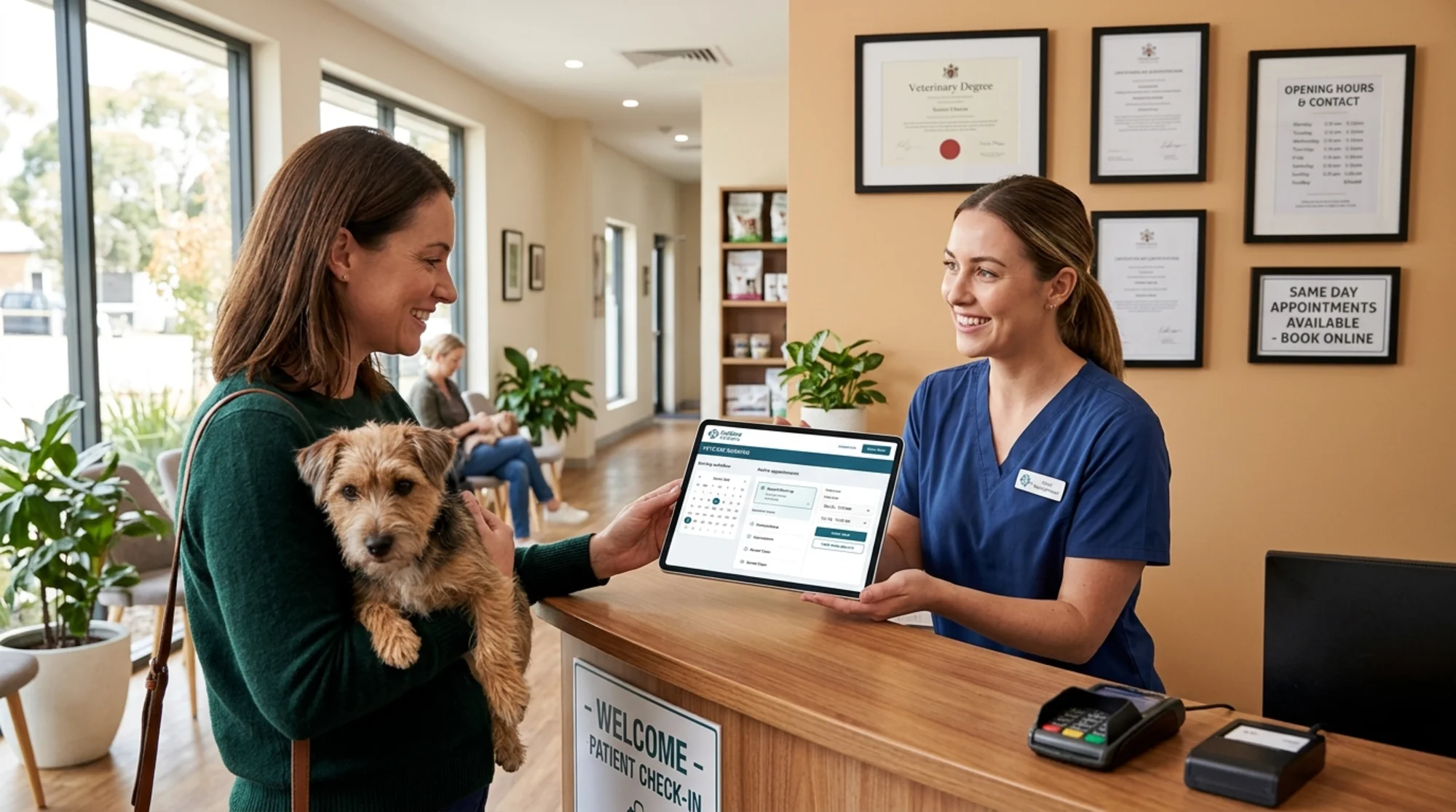
Why veterinary websites need a different lens
Pet care is a high-trust, high-urgency, hyper-local service. That changes what "good" looks like on your site:
- Urgency matters more than aesthetics. A frantic owner with a limping dog at 9pm doesn't care about your hero video. They care about your phone number, your hours, and whether you take emergencies.
- Local intent dominates. Almost all your traffic is searching for someone within driving distance. NAP consistency (name, address, phone), service area, and Google Business Profile signals carry serious weight.
- Trust is earned in seconds. Owners are choosing who to hand their animal to. Photos of the actual team, real reviews, and clear credentials beat generic "compassionate care" copy.
- Booking friction kills conversions. Every extra click between "I want an appointment" and "appointment confirmed" loses people.
A generic small-business audit will miss these. The audit you need grades your site against how a worried pet owner uses it.
The seven things to check first
Open your site in an incognito window on your phone — not your office desktop where the cache makes everything feel fast. Then run through this list:
- Phone number visible in the header on every page, tap-to-call enabled.
- Hours and emergency policy on the homepage, including weekends and holidays.
- Address with an embedded map and parking notes if parking is tricky.
- A real "Book Appointment" button that goes somewhere useful — not a contact form that takes 24 hours to answer.
- Services listed plainly — vaccinations, dental, surgery, boarding, grooming, exotics, end-of-life care, whatever you actually do.
- Team page with photos and names of your veterinarians and lead technicians.
- Online new-client paperwork so first visits don't start with a clipboard.
If any of those are missing or buried, that's your first fix list. None of it requires a redesign.
What a struggling veterinary site usually looks like
The pattern across hundreds of pet care sites:
- A beautiful homepage hero with a golden retriever, and the phone number tucked at the bottom in 12-point gray text.
- A "Services" dropdown with vague labels like "Care" and "Wellness" instead of "Vaccinations," "Spay & Neuter," "Dental Cleanings."
- A "Book Online" button that leads to a third-party portal that doesn't work on mobile.
- A homepage that takes 6+ seconds to load on 4G because someone embedded a 12 MB unoptimized photo of the clinic dog.
- An "About" page listing three vets, two of whom left in 2022.
- No structured data, so Google has to guess what kind of business this is.
If two or three of these sound familiar, you're leaking appointments. Each is fixable without rebuilding.

Technical health: the parts pet owners never see
Pet owners don't read your HTML. Google does, and Google decides whether you show up at all. Four areas matter most.
Core Web Vitals
Google publishes performance metrics called Core Web Vitals — Largest Contentful Paint (LCP), Interaction to Next Paint (INP), and Cumulative Layout Shift (CLS). In plain English: how fast does the main content appear, how quickly does the page respond when tapped, and does stuff jump around while loading?
The usual culprits on vet sites:
- Hero images that are 4000px wide when they only need to be 1200px.
- Auto-playing puppy videos that block the page from rendering.
- Third-party booking widgets that load before your phone number does.
Fix: compress images, lazy-load anything below the fold, and load booking widgets after the main content paints. See our Core Web Vitals fix guide for specifics.
Mobile usability
More than half your traffic is on a phone. Check that buttons are at least 44×44 pixels, text is readable without pinching, and forms work with autofill.
Local SEO foundations
- One consistent NAP across your site, Google Business Profile, Yelp, and vet directories.
- A dedicated location page for each clinic if you have more than one.
- Schema markup (
VeterinaryCare,LocalBusiness,OpeningHours) so Google understands what you do and when you're open. Structured data is what Google asks for when it wants to render rich results — Google's guidance on structured data is the reference.
For more on local visibility, see local SEO fixes.
Content quality
Google's helpful content guidance is blunt: write for the person, not the algorithm. For vets, that means service pages that actually answer questions:
- What happens during a dental cleaning?
- What does it cost, or a price range?
- Do you use anesthesia? What's recovery like?
- What should the owner bring or do beforehand?
A page that answers those questions outranks a page that says "We provide compassionate dental care."
A 90-minute audit walkthrough
Say you run a two-vet small animal practice. Here's how a real audit goes.
Step 1 — Run the site through a free audit tool. Use FreeSiteAudit or any equivalent. Note scores for performance, accessibility, SEO, and any flagged issues.
Step 2 — Open the site on your phone and pretend you're a new client. Time how long it takes to find the phone number, find the address, see if you're open right now, and book a wellness exam for a 1-year-old cat. Anything over 10 seconds is a problem.
Step 3 — Check your top five service pages. Does each one answer the questions a worried owner would type into Google? If your "Spay & Neuter" page is three sentences long, that's a content gap.
Step 4 — Verify Google Business Profile matches your site exactly. Hours, phone, address, services. Mismatches confuse Google and lower local rankings.
Step 5 — Check structured data. Run a page through Google's Rich Results Test. If you don't have LocalBusiness schema with hours, services, and geo coordinates, add it.
Step 6 — Look at your reviews funnel. Is there a clear, one-click way for happy clients to leave a Google review? If not, add it to your post-visit email, your invoice PDF, and your site footer.
Step 7 — Write down your top five fixes, ranked by impact divided by effort. Start with the cheapest, highest-impact ones first.
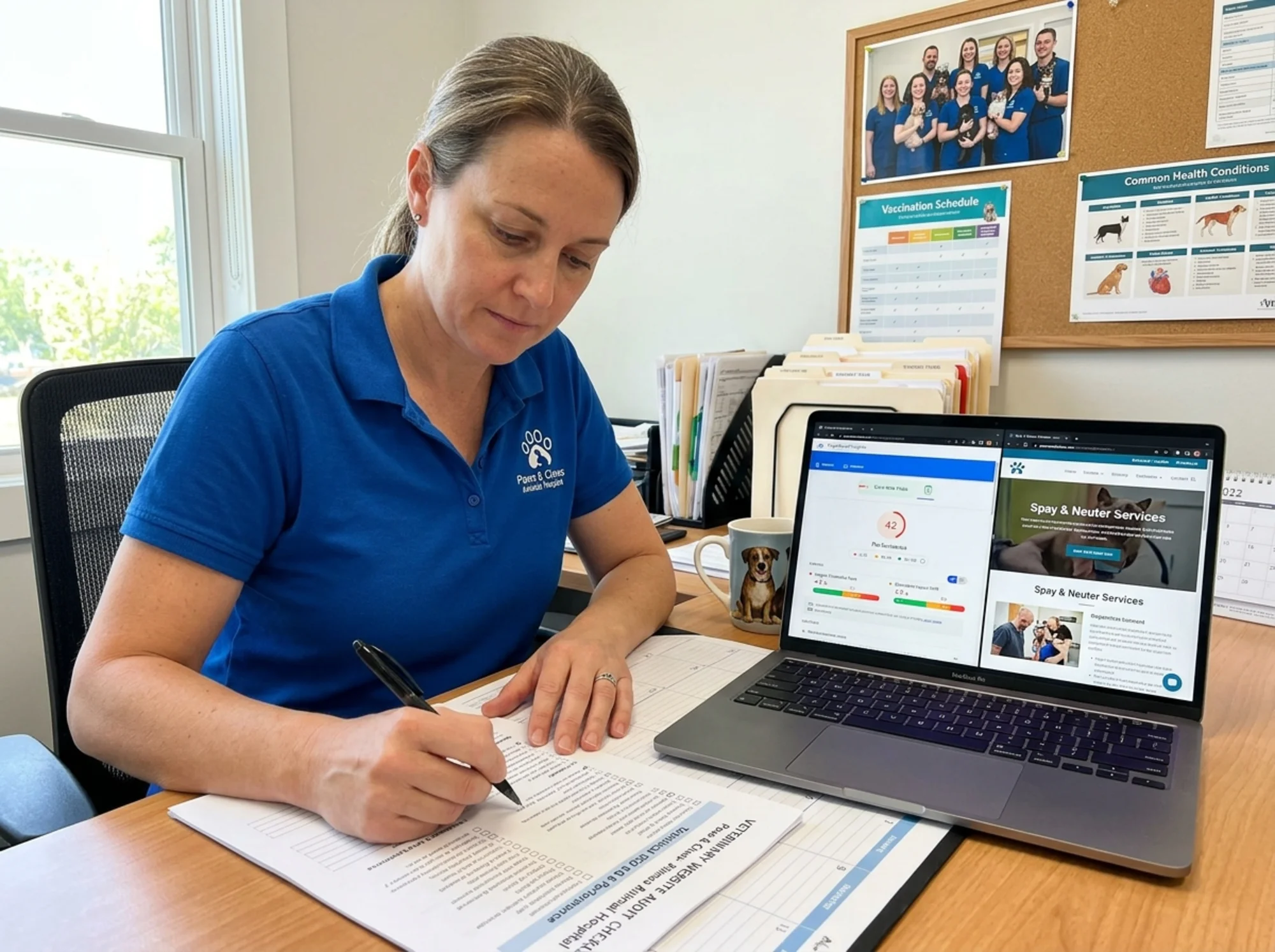
Mini-checklist for pet care sites
Walk through your site against this list:
- [ ] Phone number in the header, tap-to-call enabled
- [ ] Current hours visible without scrolling
- [ ] Emergency or after-hours guidance
- [ ] Embedded map and parking notes
- [ ] "New Client" page with online paperwork
- [ ] Services named specifically, not vague categories
- [ ] Pricing transparency where possible — even ranges help
- [ ] Real photos of the team, clinic, and exam rooms
- [ ] Google reviews visible on the homepage
- [ ] Mobile load time under 3 seconds on 4G
- [ ] HTTPS everywhere, no mixed-content warnings
- [ ]
LocalBusinessstructured data implemented - [ ] Sitemap submitted to Google Search Console
- [ ] Book or request an appointment in two taps
Tick more than 11 and you're ahead of most veterinary websites in your area.
Special cases: groomers, boarders, and mobile vets
Same principles, small twists:
- Groomers should show before/after photos and breed-specific pricing. Vague pricing ("starting at $40") loses bookings — owners don't know if their double-coated husky is going to be $40 or $140.
- Boarders need crystal-clear policies: vaccination requirements, drop-off and pick-up windows, what to bring, and what happens if a flight is delayed. A solid boarding FAQ prevents three phone calls a day.
- Mobile vets must lead with service area. A map showing your radius and a ZIP code checker beats a wall of text.
- Specialty and emergency clinics should make referral workflows obvious. Give general practitioners a dedicated referral form, not a generic contact page.
What changes after a focused fix-up
A common pattern after a good audit and one round of fixes:
- The homepage loads in under 2 seconds instead of 6.
- The phone rings more often because the number is finally visible on mobile.
- New-client form completions go up because the form actually works on phones.
- Google starts showing the clinic in the local map pack for "vet near me" because structured data and NAP consistency line up.
- Front-desk staff spend less time answering "what are your hours" calls because the answer is on every page.
None of that requires a rebrand. It requires a clear-eyed look at what's broken and the discipline to fix the highest-impact issues first.
Start with the audit, not the redesign
The biggest mistake veterinary practices make with their websites is jumping to "we need a redesign" before understanding what's actually wrong. Most of the time, the existing site is fine — it just needs the phone number raised, the images compressed, the services pages rewritten, and the structured data added. A redesign without an audit is repainting a house with a leaky roof.
Run the audit. Make a short list. Fix the cheapest, highest-impact things this week. Re-measure in 30 days.
If you want a starting point, run your site through FreeSiteAudit. It's free, it takes about a minute, and it'll give you a prioritized list of what to fix — including the technical issues that pet owners can't see but Google absolutely can. For industry-specific guidance, see our veterinary website resources.
Your patients can't speak up for themselves. Make sure your website does.
Sources
Check your website for free
Get an instant score and your top 3 critical issues in under 60 seconds.
Get Your Free Audit →