What Makes a Page a Weak AI Citation Candidate?
Learn the seven reasons AI assistants skip certain pages when recommending businesses — and the practical fixes that make your site a strong citation source.
# What Makes a Page a Weak AI Citation Candidate?
AI assistants are answering more questions every day. When someone asks ChatGPT, Google's AI Overview, or Perplexity for a recommendation — a plumber in Denver, a bakery with gluten-free options, the best accountant for freelancers — the AI pulls from web pages it considers trustworthy and clear.
Some pages get cited. Most do not.
If your business website falls into the "do not cite" pile, you are invisible in a growing channel where customers make decisions. This is not about traditional SEO rankings. A page can rank on page one of Google and still be a terrible candidate for AI citation. The reasons are specific, fixable, and worth understanding right now.

How AI Models Decide What to Cite
Large language models do not browse the web in real time the way you do. They are trained on large datasets of web content, and some (like Perplexity or Google's AI Overviews) also retrieve and read pages on the fly when answering a question. In both cases, the model needs to:
- Find your page — it has to exist in the training data or be retrievable by a search query.
- Parse your page — the model needs to extract specific, usable facts from your content.
- Trust your page — the content needs signals that suggest it is accurate and authoritative.
- Prefer your page — when multiple sources say similar things, the model picks the one that is clearest, most specific, and best structured.
A weak AI citation candidate fails at one or more of these steps. Here is exactly what goes wrong.
The Seven Traits of Pages AI Ignores
1. Vague, Generic Content
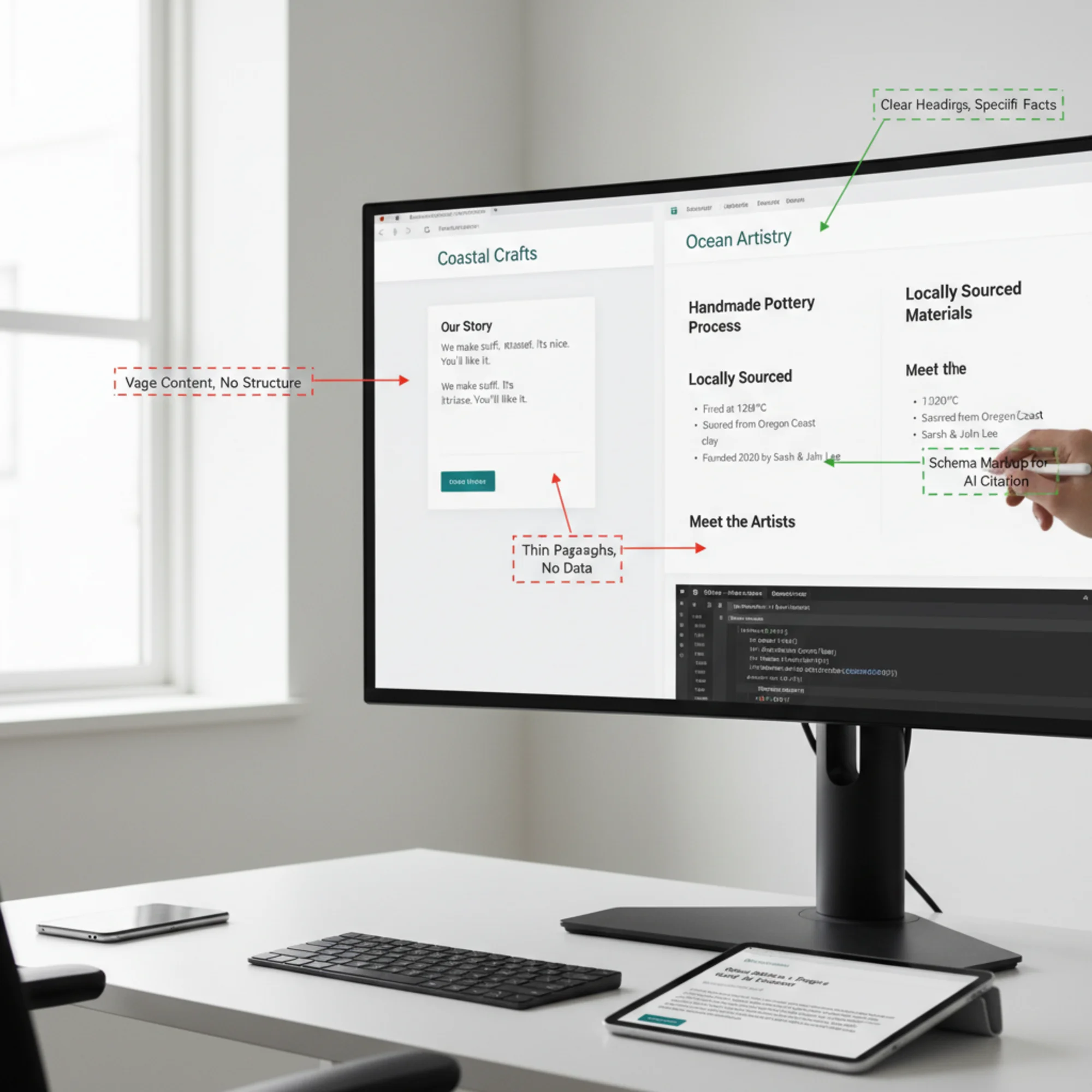
This is the single biggest problem. Pages full of sentences like "We provide excellent customer service" or "Our team is dedicated to quality" give an AI model nothing to work with.
When someone asks an AI "Which bakeries in Portland offer custom wedding cakes?" the model looks for pages that contain specific facts: the bakery's name, its location in Portland, the fact that it makes custom wedding cakes, pricing ranges, lead times, and flavors available.
A page that says "We bake beautiful cakes for all occasions" does not answer the question. A page that says "We make custom wedding cakes starting at $350, with 30+ flavor options, and need 3 weeks lead time for orders" gives the AI exactly what it needs to cite you.
Quick test: Read your main service pages. Could an AI extract three specific facts from each page that directly answer a customer question? If not, the content is too vague.
2. No Clear Entity Information
AI models work with entities — people, businesses, places, products. Your page needs to make it unmistakably clear what entity it represents.
This means:
- Business name — stated clearly, not just in the logo
- Location — full address, not just "serving the greater metro area"
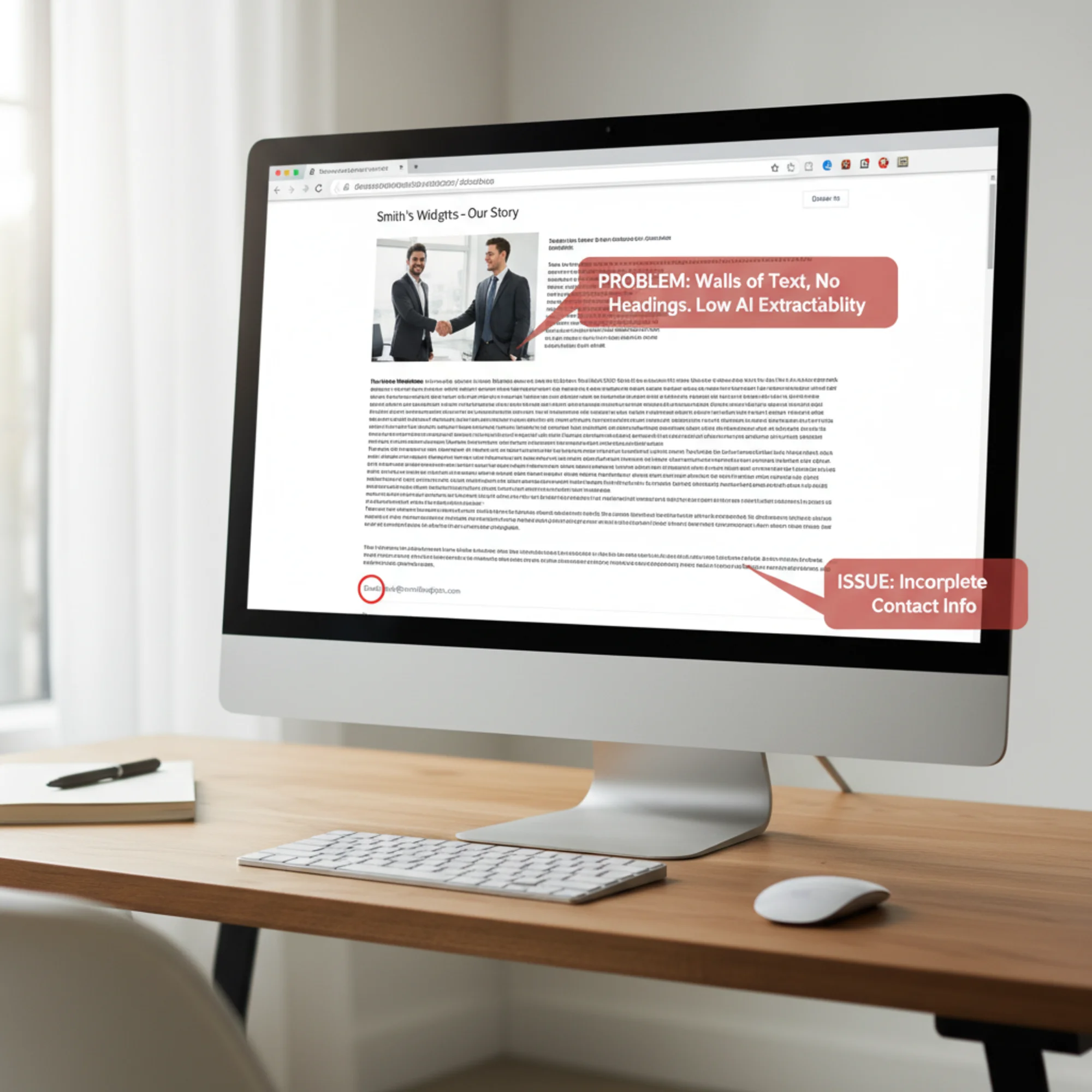
- Contact information — phone number and email visible on the page
- What you do — stated plainly in the first few sentences
- What makes you different — specific credentials, specialties, or offerings
Pages that bury this information in footers, hide it behind "Contact Us" buttons, or assume visitors already know who you are make weak citation candidates. The AI cannot cite what it cannot find quickly.
3. Missing or Weak Structured Data
Structured data (Schema.org markup) is machine-readable information embedded in your page's code. It tells search engines and AI models exactly what your page is about in a format they can parse without guessing.
A page without structured data forces the AI to interpret your natural language and hope it gets the meaning right. A page with proper structured data hands the AI a clean, organized set of facts.
For a local business, this means LocalBusiness schema with your name, address, phone, hours, and service type. For a blog post, Article schema with author, date, and topic. For a product, Product schema with price, availability, and reviews.
Google's own documentation on structured data for articles makes the case clearly: structured data helps systems understand your content. AI citation systems benefit from the same clarity.
What to check:
- Does your homepage have
LocalBusinessorOrganizationschema? - Do your service pages have
Serviceschema? - Do your blog posts have
Articleschema with author and date? - Is your schema valid? (Test it with Google's Rich Results Test)
4. Poor Page Structure and Headings
AI models parse pages hierarchically. They use your H1 to understand the main topic, H2s for subtopics, and the content under each heading for supporting details. A page with no headings, or with headings that do not describe the content below them, is harder for a model to parse accurately.
Common problems:
- No headings at all — just a wall of paragraphs
- Decorative headings — vague labels like "Our Story" or "Why Us" that contain no searchable terms
- Skipped heading levels — jumping from H1 to H4
- Multiple H1 tags — confuses the page's primary topic
- Headings that do not match the content — an H2 that says "Services" followed by a team bio
Good structure looks like this:
H1: Custom Wedding Cakes in Portland | [Bakery Name]
H2: Wedding Cake Flavors and Options
H2: Pricing and Packages
H2: How to Order
H2: Delivery and Setup
Each heading tells the AI exactly what information lives in that section. When someone asks about wedding cake pricing in Portland, the model can go straight to the relevant section and extract a clear answer.
5. Thin or Duplicate Content
Pages with only a sentence or two give the AI nothing substantial to cite. Similarly, pages that repeat the same content across multiple URLs — common with location pages or service variations — create confusion about which page is authoritative.
If you have five service pages and each one shares the same three paragraphs with just the service name swapped out, none of them are strong citation candidates. The AI sees thin, templated content and moves on to a competitor whose pages have genuine detail about each service.
Minimum content guideline: Each page that you want cited should have at least 300 words of unique, specific content that answers real questions about that topic.
6. Slow, Broken, or Inaccessible Pages
Google's Core Web Vitals measure how fast and stable your pages are. While AI models are not directly measuring your load time, the systems that feed content to AI models — search indexes, web crawlers — absolutely are. Pages that load slowly, throw errors, or block crawlers get indexed poorly or not at all.
If a page is not in the index, it cannot be cited.
Common accessibility problems that hurt AI citation:
- JavaScript-only rendering — if your content only appears after JavaScript executes, many crawlers see a blank page
- Broken links or 404 errors — signal a poorly maintained site
- No mobile version — modern crawlers use mobile-first indexing
- Blocked by robots.txt — you might be accidentally telling crawlers not to read your best content
- Extremely slow load times — crawlers may time out before getting your content
7. No Demonstrable Expertise or Authority
Google's helpful content guidelines emphasize experience, expertise, authoritativeness, and trustworthiness. AI models draw from these same signals, directly or indirectly.
Pages that lack author attribution, mention no credentials, cite no sources, and contain only surface-level information read as low-authority content. An AI model choosing between two pages on the same topic will favor the one that demonstrates genuine knowledge.
For a small business, authority signals include:
- Named people — credentials, years of experience, certifications
- Evidence of real work — case studies, before/after examples, specific project descriptions
- External mentions — reviews, press coverage, directory listings, and backlinks all reinforce authority
- Current content — outdated pages with old dates signal neglect
Fixing a Weak Page: A Walkthrough
Say you run a dog grooming business in Austin, Texas. Your services page currently reads:
> Our Services
>
> We offer a full range of grooming services for dogs of all sizes. Our experienced team will make your pup look and feel great. Contact us to book an appointment!
This page is a weak AI citation candidate. Here is what to change:
Problem 1: No specific services listed.
Fix: List every service — bath and brush, full groom, nail trim, teeth cleaning, de-shedding treatment, puppy's first groom. Include what each service includes and what it costs.
Problem 2: No location specifics.
Fix: Mention Austin, your neighborhood, and your full address. "Located in South Austin on Lamar Blvd, serving 78704 and surrounding areas."
Problem 3: No structured data.
Fix: Add LocalBusiness schema with PetGrooming as the type, including your hours, price ranges, and service area.
Problem 4: No expertise signals.
Fix: Mention certifications ("Certified by the National Dog Groomers Association of America"), years in business, and number of dogs groomed. Add breed-specific grooming knowledge.
Problem 5: No answerable questions.
Fix: Add an FAQ section with real questions: "How long does a full groom take?" "Do you groom aggressive dogs?" "What breeds do you specialize in?"
The fixed page gives an AI model clear, specific, citable facts. When someone asks "Where can I get my golden retriever groomed in South Austin?" the AI has everything it needs to mention your business by name.
Your AI Citation Readiness Checklist
Run through this for every important page on your site:
- [ ] Specific facts — Does the page contain at least 5 concrete facts (prices, locations, hours, specialties, credentials)?
- [ ] Clear entity — Is it obvious within 3 seconds what business this page belongs to and where it is located?
- [ ] Structured data — Does the page have valid Schema.org markup matching its content type?
- [ ] Logical headings — Does the page use H1/H2/H3 headings that describe the content beneath them?
- [ ] Sufficient depth — Does the page have at least 300 words of unique, non-templated content?
- [ ] Fast and accessible — Does the page load in under 3 seconds and work without JavaScript?
- [ ] Author and expertise — Does the page show who created it and why they are qualified?
- [ ] Freshness — Has the page been updated in the last 12 months?
- [ ] Answerable questions — Could you pull 3 direct answers to customer questions from this page?
- [ ] External validation — Is this business mentioned on other reputable sites (reviews, directories, press)?
What to Fix First
If you are overwhelmed, start with these three changes. They address the most common reasons pages get skipped:
- Add specific facts to your top 3 pages. Replace every vague claim with a concrete detail. Numbers, names, locations, credentials, prices.
- Add LocalBusiness structured data to your homepage. This one technical change makes your basic business information machine-readable. Many website platforms have plugins or built-in options for this.
- Write an FAQ section on each service page. Use actual questions your customers ask. Answer each one in 2-3 sentences with specific information. This gives AI models ready-made question-and-answer pairs.
These three changes can move a page from invisible to citable in a matter of days.
Check Where Your Site Stands
You do not have to guess which of these problems affect your pages. Run a free audit at FreeSiteAudit to get a breakdown of your site's structure, content clarity, schema markup, page speed, and more. The audit flags the specific issues that make pages weak candidates for both search engines and AI citation — so you know exactly what to fix and where to start.

The Bottom Line
AI citation is not a mystery. Models cite pages that are clear, specific, well-structured, and trustworthy. They skip pages that are vague, thin, poorly organized, or hard to parse.
Every fix on this list is something you can do yourself, most without writing a single line of code. Start with your most important page, make it impossible for an AI to misunderstand what you do, and work outward from there.
The businesses that show up in AI answers will not be the ones with the biggest ad budgets. They will be the ones with the clearest, most specific, best-organized information on their websites. That is a competition any small business can win.
Sources
Check your website for free
Get an instant score and your top 3 critical issues in under 60 seconds.
Get Your Free Audit →